
Resource Library
Any CA4SH partner can submit a resource to the Library, where we hope to increase visibility of diverse work related to improving soil health globally.
Please send a web link or a file to communications@coalitionforsoilhealth.org if you would like to submit a resource.

Enabling Coherence for Sustainable Land Management and Climate Policy
This synthesis paper is a product of a first workshop on upscaling the potential of soil organic carbon for climate action, held in April 2020. Experts came together for the “Climate-Soil Community of Practice” to disseminate information on successful land management and soil carbon projects, highlight good practices for overcoming adoption barriers and strengthen the case for sustainable land management as a key to effective climate action. This synthesis paper presents the outcomes of the presentations and discussions derived during the event on the linkages between sustainable land management and climate change. It aims to provide guidance on a holistic approach to land use and climate policy processes within the scope of international agendas and national actions. It offers entry points at the national level and presents good practices to current barriers in aligning these two closely interconnected, yet often separately treated processes.
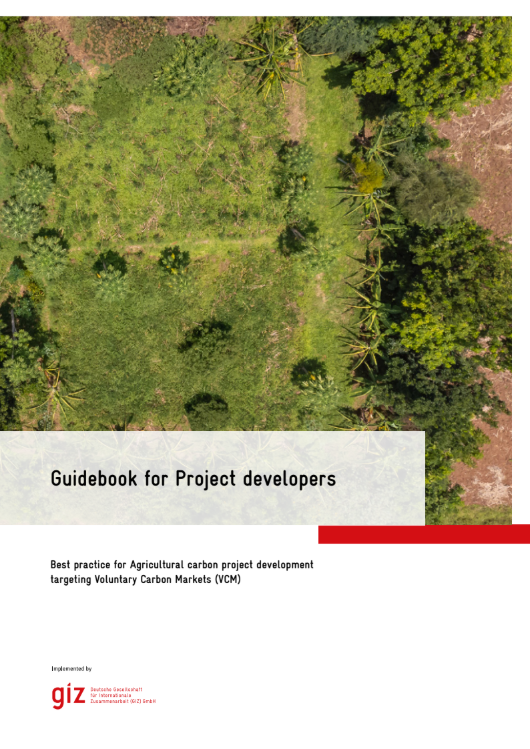
Guidebook for Project developers: Best practice for Agricultural carbon project development targeting Voluntary Carbon Markets (VCM)
This guidebook aims to inform the design of agricultural carbon projects and to support project developers in navigating key project development issues, drawing on lessons learnt from a pilot project; the Western Kenya Soil Carbon Project (WKCP) as well as feasibility studies in India and Madagascar.
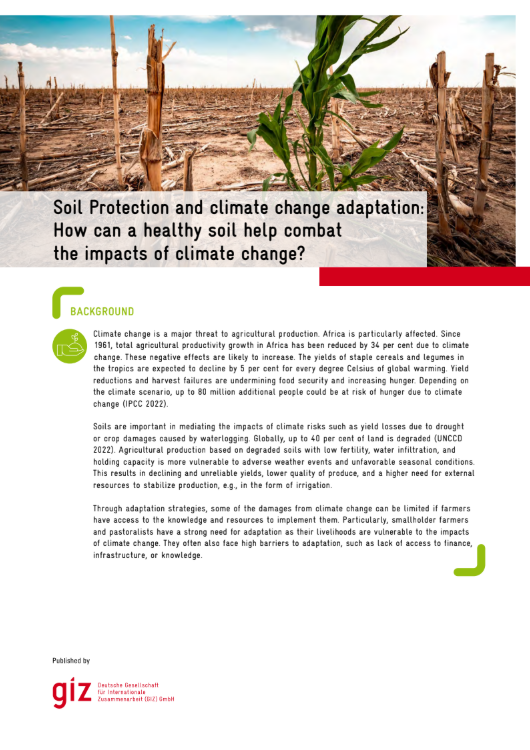
Soil Protection and climate change adaptation: How can a healthy soil help combat the impacts of climate change?
Climate change is a major threat to agricultural production. Africa is particularly affected. Since 1961, total agricultural productivity growth in Africa has been reduced by 34 per cent due to climate change. These negative effects are likely to increase. The yields of staple cereals and legumes in the tropics are expected to decline by 5 per cent for every degree Celsius of global warming. Yield reductions and harvest failures are undermining food security and increasing hunger. Depending on the climate scenario, up to 80 million additional people could be at risk of hunger due to climate change (IPCC 2022).

Completing the integrated soil fertility management equation: Latest trends in research and scaling for organic and auxiliary inputs
This toolkit aims to provide nuanced information about key entry points of the six featured technologies within the broader context of ISFM (Figure 3). By compiling up-to-date evidence from research and case studies we discuss the potential benefits for crop production and complementarity with synthetic fertilizer. Critical reflections are made of lessons learned and innovative incentive mechanisms that can help production and use. We also provide examples of how policies and investments can be designed to create practical ways for farmers to access and use technologies that enhance soil health. This toolkit is intended for development organizations and the policy sector to accelerate dissemination and uptake at scale of organic inputs and other amendments with proven ability to maintain and enhance soil health in food production systems of SSA. In light of the Fertilizer and Soil Health Strategy for the next 10 years, the insights provided in this toolkit can aid decision-makers. By assessing the technical aspects and scalability, the toolkit advances understanding to leverage and guide research, commercial investments and policy design. The scope of the assessments in the toolkit includes upland annual and perennial cropping systems such as grains, roots, tubers, and bananas because they represent the largest geographic area and staple food in smallholder systems of SSA.

Assessing the adaptation relevance of soil protection and rehabilitation: A participatory multi-stakeholder approach for monitoring and evaluation
This guide presents a systematic approach to identify relevant climatic risks and evaluate the effectiveness of SPR technologies regarding these risks as well as the local feasibility of these technologies. The presented methodology strikes a balance between rigor and practicability. The multistakeholder approach and the participatory elements offer opportunities for networking and sensitization of local experts, policy makers, extension officers and most important - farmers themselves. First experiences demonstrate that opening this space allows for fruitful and empowering exchanges.

Improving the Nationally Determined Contribution of the Republic of Benin: Challenges, Needs for Support, and Opportunities for Future Engagements
The analysis is based on a desk review of relevant documents and interviews with key informants who participated in the NDC development process. This helped to understand the NDC development process, highlight the level of integration of SOC/SH into the NDCs, and formulate relevant recommendations based on key areas of support.

Economic benefits through agroecological soil practices
Soils worldwide are degrading at an accelerating rate with devastating effects on agricultural productivity and thus food security. Farmers can directly address this challenge by adopting agroecological practices that help maintain or enhance soil fertility over the long term. Evidence from 10 years of implementation of ProSoil shows that these measures not only improve soil fertility but also have a positive economic impact for both farmers and society as a whole. Case studies from ProSoil have been analysed.

Soil protection and reduction of greenhouse gas emissions: How can a healthy soil contribute to climate change mitigation?
Climate change poses a threat to global agriculture, with the African continent particularly vulnerable. Since 1961, climate change has reduced agricultural productivity in Africa by 34 per cent. Projections warn that up to 80 million additional people could be affected by hunger. Already today, 40 per cent of the world’s land area is considered degraded. At the same time, agricultural activities contribute considerably to the degradation of ecological and agricultural systems.

Le Biochar et al Terra Preta pour une Agriculture Durable au Benin: Quatre Ans d’Experience et de Mise en Oeuvre par ProSol Benin
Au Bénin, les sols s’épuisent à un rythme accéléré du fait des mauvaises pratiques culturales, des conditions climatiques et de l’utilisation abusive des engrais minéraux. Une étude faite en 2016 sur le niveau de fertilité des sols par le Laboratoire d’Appui à l’Amélioration de la Santé des Sols, de la qualité des Eaux et à la sauvegarde de l’Environnement (L2A2S2E) de l’Institut National des Recherches Agricoles du Bénin (INRAB) a révélé que 90 % des sols du Bénin ont un niveau de fertilité faible à très faible, notamment dans les départements du Borgou, de l’Alibori et du Zou. Cela entraine des conséquences telles que la diminution des rendements des cultures, la menace à la sécurité alimentaire, l’augmentation de la pauvreté ainsi que la menace à l’environnement et à la santé humaine.
Pour inverser cette situation, le projet « Protection et Réhabilitation des Sols (ProSOL) » promeut la mise en œuvre à large échelle des approches de protection et de réhabilitation durables des sols au Bénin. Le biochar, la Terra Preta et le compost sont des innovations parmi les mesures de Gestion Durable des Terres (GDT) diffusées par ProSOL.

Émissions de gaz à effet deserre de différents concepts de production de compost à Madagascar
Le carbone, qui a été produit à partir du compost et dont la durée de vie est liée durable, contribue à réduire la quantité de CO2 qui a été produite lors de l'épuisement de la biomasse utilisée et qui a été produite à partir du compost.
Les processus de compostage et l'application de compost aux sols agricoles interagissent avec l'environnement et le système climatique de multiples façons complexes, ce qui entraîne de nombreuses incertitudes.
Afin de réduire ces incertitudes à l'avenir et d'accroître la robustesse des résultats comptables, des mesures des valeurs d'émission réelles ou du carbone séquestré devraient être effectuées régulièrement au cours de la mise en œuvre et de l'exploitation des technologies étudiées en Madagascar.

Les Mesures D'Adaptation aux Effets du Changement Climatique (Mesures ACC) Promues par le ProSol Benin
Le Bénin à l'instar d'autres pays en Afrique, est dans une dynamique de lutte contre les effets du changement climatique à travers l'établissement d'un cadre de gouvernance et des mécanismes de coordination institutionnelle (CNCC. MCVDD, CMEICB, FNEC, CTPNA, etc.) ainsi que l'adoption de politiques/stratégies opérationnalisées par la mise en œuvre de projets et de programmes. Ces mesures permettront de rendre la production agricole résiliente aux effets du changement climatique afin de garantir la sécurité alimentaire. L'intervention du ProSOL sur la Gestion Durable des Terres et l'Adaptation au Changement Climatique (GDT/ACC) promues dans ses zones d'intervention vient dès lors à point nommé pour contribuer à cette dynamique déjà en cours au Bénin.

Émissions de gaz à effet de serre des substrats de Terra Preta au Bénin
La mise en place depuis 2020 du système de Semence de Qualité Déclarée (SQD) dans le Boeny marque une avancée significative dans l’amélioration de la qualité des semences ainsi que le soutien à une agriculture plus durable dans la région.
Ce système SQD répond à la nécessité d’améliorer l’accès des paysan·ne·s à des semences de meilleure qualité et de variétés bien adaptées aux conditions agroécologiques spécifiques de la région Boeny.
Ce document présente en détail les trois axes clés du déploiement du système SQD dans la région : (1) la définition et la mise en place des Normes de certification des semences, (2) l’inscription des variétés locales au Registre SQD Boeny et (3) la formation des paysan·ne·s multiplicateur·rice·s de semences.

Greenhouse gas emissions from Terra Preta substrates in India
For all investigated concepts, the production and application of the Terra Preta Substrate (TPS) lead to negative emission results under the selected assumptions, resulting from an assumed carbon sequestration that exceeds the greenhouse gas emissions from the production of the TPS. Whereby, the concepts with advanced pyrolysis technology are the most advantageous due to the reduced CH4 emissions from pyrolysis.
Emissions of methane and nitrous oxide from composting and pyrolysis process are by far the most significant emission sources in the overall result. The result shows a high influence of carbon sequestration in the overall balance. The carbon introduced and permanently sequestered, mainly via the biochar, leads to high CO2 credits.
TPS production, including pyrolysis and composting processes, and the application to agricultural soils interact with the environment and climate system in multiple complex ways, this results in many uncertainties.
In order to reduce these ranges in the future and to further increase the robustness of the accounting results, measurements of actual emission values or sequestered carbon should be taken regularly during the further implementation and operation of the investigated technologies in India.
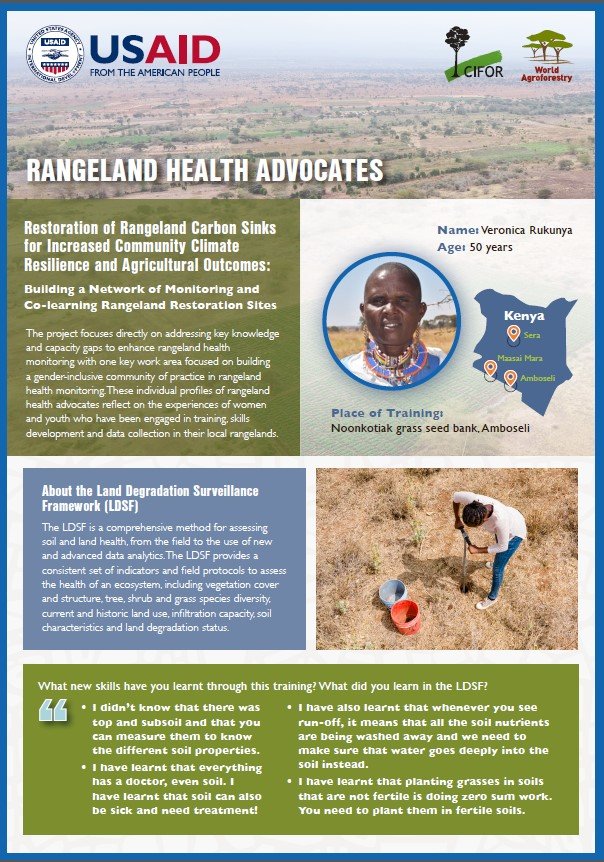
Advocate Briefs: Restoration of Rangeland Carbon Sinks for Increased Community Climate Resilience and Agricultural Outcomes
The Restoration of Rangeland Carbon Sinks focuses directly on addressing key knowledge and capacity gaps to enhance rangeland health monitoring with one key work area focused on building a gender-inclusive community of practice in rangeland health monitoring.
These individual profiles of rangeland health advocates reflect on the experiences of women and youth who have been engaged in training, skills development and data collection in their local rangelands.
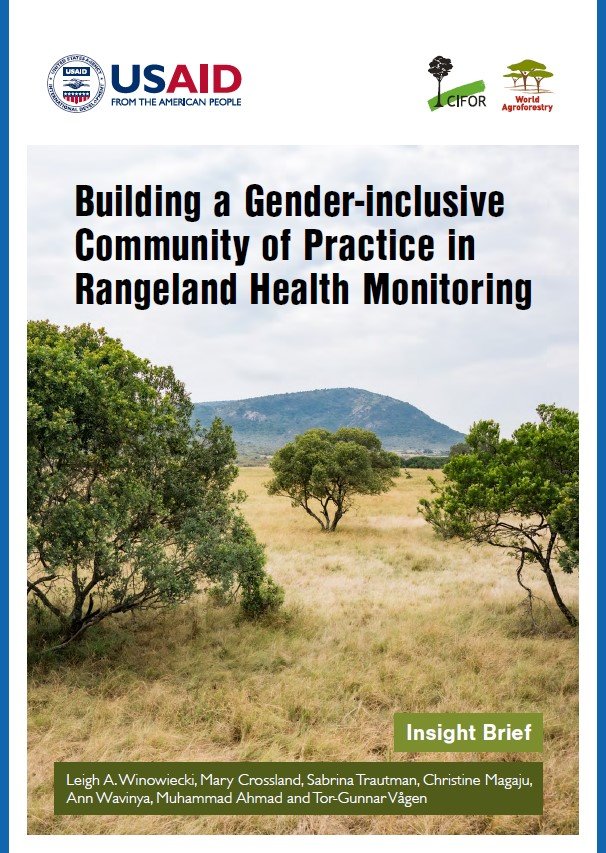
Building a Gender-inclusive Community of Practice in Rangeland Health Monitoring
This brief summarizes the capacity development activities undertaken by the project Restoration of Rangeland Carbon Sinks to build gender inclusive community of practice in rangeland health monitoring.
Specifically, the brief outlines the critical need to address gender inequalities in rangeland health monitoring and synthesises reflections from women and youth on skills they have built through capacity development activities. The brief also highlights the impact these activities are having not only in their own agency and development, but also the wider implications and impact they want to create in their communities as a result of the skills they have built and been exposed to.

Special Issue of the BAIF Journal: Carbon Offsetting and Neutrality
BAIF has been forging partnerships with global and national agencies for leveraging the strengths of the actors engaged in climate action. During the last couple of years, BAIF received accreditation as an Observer Organisation status for UNFCCC's COP as well as provisional status for UNCCD, BAIF has become a member of the Global EverGreening Alliance (GEA) Australia, Coalition of Action for Soil Health (CA4SH), International Biochar Initiative, United States and World Bioenergy Association, Sweden. Partnerships have also been developed within the country to share knowledge and undertake projects on climate change mitigation.
This issue, with its focus on the carbon offsetting and neutrality efforts of BAIF, serves as an eye opener for acceleration of voluntary action and working towards net-zero emissions, the most important goal of all responsible organisations.

Natural Carbon Sequestation: Leveraging Soils for Mitigation, Storage & Biodiversity Benefits
This presentation was given in a side event from the British Society of Soil Science at the UNFCCC COP28 in Dubai.
Learn more and download the presentation

SOIL the hidden part of the climate cycle
Excerpt:
“Soil is a natural resource which most of us either ignore or take for granted. Yet the thin layer of ‘dirt’ that covers much of the surface of the Earth is vital to the environment and invaluable to our societies.
However, soil quality is declining in many areas, meaning that it is less able to perform its essential functions. One area of concern is the effect of soil degradation on the climate, and vice versa.”
Read the full report from the European Commission (2011)

Policy Brief: Healthy soils sustain food system transformations to contribute to the net zero CO2 emission target by 2050
Business as usual strategies for agriculture, land use and land use changes will impede the contribution of the food systems to the net zero CO2 emission ambition.
Food system transformation is needed for "safeguarding food security and ending hunger, and the particular vulnerabilities of food production systems to adverse impact of climate change3".
Read the policy brief from 4p1000, CIRAD, and IRD
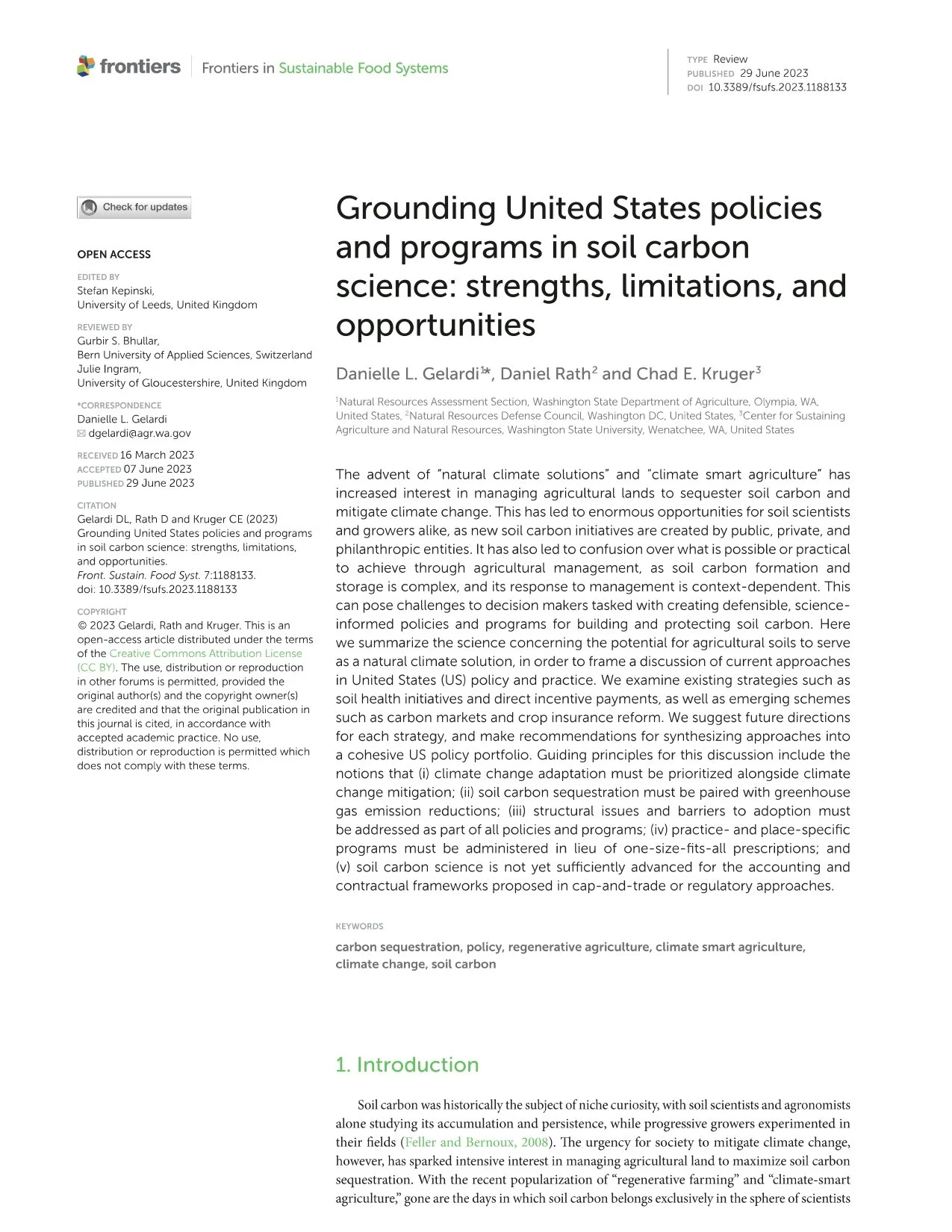
Grounding United States policies and programs in soil carbon science: strengths, limitations, and opportunities
Abstract
The advent of “natural climate solutions” and “climate smart agriculture” has increased interest in managing agricultural lands to sequester soil carbon and mitigate climate change. This has led to enormous opportunities for soil scientists and growers alike, as new soil carbon initiatives are created by public, private, and philanthropic entities. It has also led to confusion over what is possible or practical to achieve through agricultural management, as soil carbon formation and storage is complex, and its response to management is context-dependent… cont.