Resource Library
Any CA4SH partner can submit a resource to the Library, where we hope to increase visibility of diverse work related to improving soil health globally.
Please send a web link or a file to communications@coalitionforsoilhealth.org if you would like to submit a resource.

Land Matters! Integrating soil degradation concerns and solutions into policy processes
The Global Programme „Soil protection and rehabilitation for food security“ which is implemented by GIZ on behalf of the German Federal Ministry for Economic Cooperation and Development, works with partners who identified the need for sharing and implementing sustainable approaches for soil protection and rehabilitation in six countries (Benin, Burkina Faso, Ethiopia, India, Kenya and Madagascar). At the political level, the programme advises the partner governments on improving general political conditions. The governments have to create incentives for farmers and smaller enterprises to use the soil in more sustainable ways. To support these national activities, the programme organizes international forums that encourage participants to share lessons learned.
The Land Matters! Integrating soil degradation concerns and solutions into policy processes Massive Open Online Course (MOOC) is contributing to the aforementioned Global Programme. Many academics and practitioners struggle to support decision making which takes into account land use related trade-offs in ecosystem service provision, even though many have evidence of such trade-offs. The MOOC therefore helps them in finding ways to support decision-making. It is hosted on the GIZ online platform, Global Campus 21.

Implementing agroecology through soil protection
Agroecology is an integrated and holistic approach to sustainable agricultural and food systems, from production to consumption. It is pursued in three dimensions: science, agricultural practices, and a social movement. The 13 agroecological principles of the HLPE (2019) provide guidance for its implementation.

Soil health and crop nutrient management: Building resilience and increasing the efficiency of nutrient application
Soil health is fundamental for the productivity of cropping systems. It relies on three interlinked pillars: (1) availability of sufficient nutrients, (2) organic matter and (3) soil biota. Organic matter regulates pH and supports nutrient availability, water retention and soil biodiversity. Soil biotas decompose organic matter and improve soil structure by forming soil aggregates.
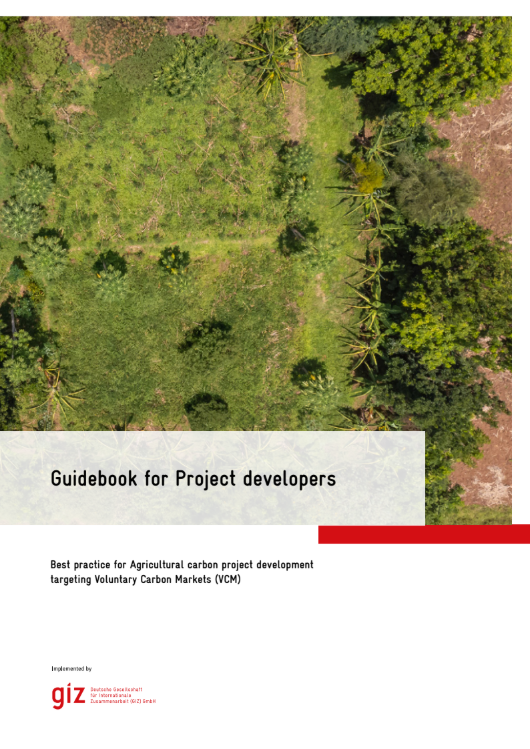
Guidebook for Project developers: Best practice for Agricultural carbon project development targeting Voluntary Carbon Markets (VCM)
This guidebook aims to inform the design of agricultural carbon projects and to support project developers in navigating key project development issues, drawing on lessons learnt from a pilot project; the Western Kenya Soil Carbon Project (WKCP) as well as feasibility studies in India and Madagascar.

Gender in Soil Matters: Comparative Insights from Multi-Country Gender Analyses
This synthesis report examines how gender is implicated in soil health interventions across diverse country contexts, and how Soil Matters as a global programme can respond with both gender-responsive and gender-transformative approaches. It draws on national gender analyses conducted between 2024–2025, offering cross-country insights, strategic recommendations, and key entry points to ensure that gender equality is not only acknowledged but actively pursued within the programme’s design, delivery, and scaling pathways.nger. Depending on the climate scenario, up to 80 million additional people could be at risk of hunger due to climate change (IPCC 2022).
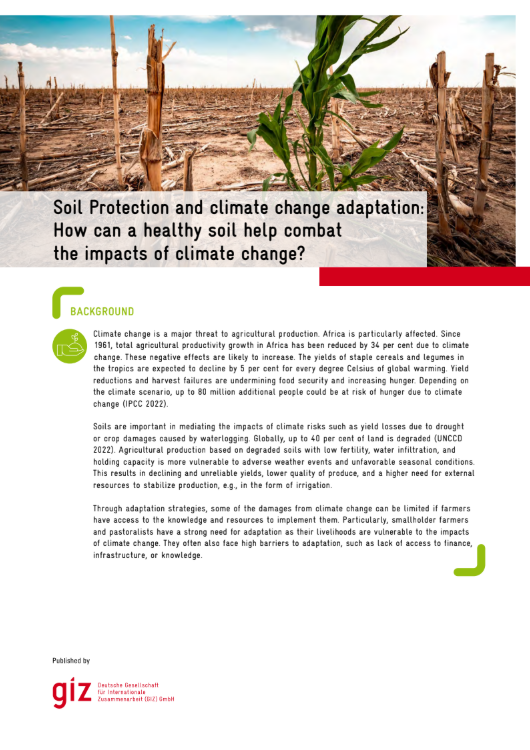
Soil Protection and climate change adaptation: How can a healthy soil help combat the impacts of climate change?
Climate change is a major threat to agricultural production. Africa is particularly affected. Since 1961, total agricultural productivity growth in Africa has been reduced by 34 per cent due to climate change. These negative effects are likely to increase. The yields of staple cereals and legumes in the tropics are expected to decline by 5 per cent for every degree Celsius of global warming. Yield reductions and harvest failures are undermining food security and increasing hunger. Depending on the climate scenario, up to 80 million additional people could be at risk of hunger due to climate change (IPCC 2022).

Sowing Sustainability: Agroecology and Sustainable Land Management in Synergy
This compilation consists of ten selected SLM practices that contribute to improved soil fertility and enhance soil health for the sustainability of food and agricultural systems.

Fields of Harmony: Pulses and Sustainable Land Management
This compilation consists of ten selected SLM practices that contribute to improved soil fertility and enhance soil health for the sustainability of food and agricultural systems.

Harvesting Tomorrow: Advancing Sustainable Land Management for Soil Fertility
This compilation consists of ten selected SLM practices that contribute to improved soil fertility and enhance soil health for the sustainability of food and agricultural systems.

Completing the integrated soil fertility management equation: Latest trends in research and scaling for organic and auxiliary inputs
This toolkit aims to provide nuanced information about key entry points of the six featured technologies within the broader context of ISFM (Figure 3). By compiling up-to-date evidence from research and case studies we discuss the potential benefits for crop production and complementarity with synthetic fertilizer. Critical reflections are made of lessons learned and innovative incentive mechanisms that can help production and use. We also provide examples of how policies and investments can be designed to create practical ways for farmers to access and use technologies that enhance soil health. This toolkit is intended for development organizations and the policy sector to accelerate dissemination and uptake at scale of organic inputs and other amendments with proven ability to maintain and enhance soil health in food production systems of SSA. In light of the Fertilizer and Soil Health Strategy for the next 10 years, the insights provided in this toolkit can aid decision-makers. By assessing the technical aspects and scalability, the toolkit advances understanding to leverage and guide research, commercial investments and policy design. The scope of the assessments in the toolkit includes upland annual and perennial cropping systems such as grains, roots, tubers, and bananas because they represent the largest geographic area and staple food in smallholder systems of SSA.

Assessing the adaptation relevance of soil protection and rehabilitation: A participatory multi-stakeholder approach for monitoring and evaluation
This guide presents a systematic approach to identify relevant climatic risks and evaluate the effectiveness of SPR technologies regarding these risks as well as the local feasibility of these technologies. The presented methodology strikes a balance between rigor and practicability. The multistakeholder approach and the participatory elements offer opportunities for networking and sensitization of local experts, policy makers, extension officers and most important - farmers themselves. First experiences demonstrate that opening this space allows for fruitful and empowering exchanges.

Economic benefits through agroecological soil practices: Evidence by ProSoil
This compilation of economic evidence looks at the studies and reports about ProSoil activities that were carried out between 2014 to 2023, many in partnership with the Economics of Land Degradation (ELD) Initiative (www.eld-initiative.org). They were analysed in terms of their economic, social, environmental and benefits as the compilation sought to answer two key questions:
I. Are agroecological practices economically viable for smallholder farmers?
II. What are the wider economic and social benefits of agroecological practices?

Cross-Country Analysis on Integrating Farmers’ Knowledge into Extension Approaches for Accelerated Agroecological Transition
This report examines agricultural extension approaches that integrate farmers' knowledge to accelerate agroecological transitions in Benin, Ethiopia, Kenya, and Madagascar. It assesses how advisory services support sustainable farming, foster knowledge-sharing, and ensure long-term farmer engagement.

Improving the Nationally Determined Contribution of the Republic of Benin: Challenges, Needs for Support, and Opportunities for Future Engagements
The analysis is based on a desk review of relevant documents and interviews with key informants who participated in the NDC development process. This helped to understand the NDC development process, highlight the level of integration of SOC/SH into the NDCs, and formulate relevant recommendations based on key areas of support.

Economic benefits through agroecological soil practices
Soils worldwide are degrading at an accelerating rate with devastating effects on agricultural productivity and thus food security. Farmers can directly address this challenge by adopting agroecological practices that help maintain or enhance soil fertility over the long term. Evidence from 10 years of implementation of ProSoil shows that these measures not only improve soil fertility but also have a positive economic impact for both farmers and society as a whole. Case studies from ProSoil have been analysed.

Soil protection and reduction of greenhouse gas emissions: How can a healthy soil contribute to climate change mitigation?
Climate change poses a threat to global agriculture, with the African continent particularly vulnerable. Since 1961, climate change has reduced agricultural productivity in Africa by 34 per cent. Projections warn that up to 80 million additional people could be affected by hunger. Already today, 40 per cent of the world’s land area is considered degraded. At the same time, agricultural activities contribute considerably to the degradation of ecological and agricultural systems.

Soil protection – a trigger for the transformation towards sustainable agricultural and food systems
Agricultural and food (in short here agrifood) systems encompass the entire value chain of food and agricultural production, from seed selection and crop cultivation to storage, transport, processing, marketing, consumption, and waste management. These systems are shaped by social, economic, and policy factors.

Nurturing the Earth: The Role of Soil Protection and Rehabilitation for Food Security
The main objective of this study is to analyse the existing studies and sources in order to compile and prepare evidence on the link between ProSoil’s actions on food security in a communicative way key messages) for communication purposes and for accountability of the commissioning party and co-funders. Accordingly, conclusions and key messages are presented in chapter 5.

The role of integrated soil fertility management in improving crop yields in the Ethiopian Highlands
Land degradation and declining productivity in the Ethiopian Highlands are primarily caused by soil fertility decline due to erosion, nutrient depletion, and soil acidity. An integrated soil fertility management (ISFM) project operating over a six-year period aimed to combat this and boost yields through participatory demonstrations. Despite high levels of yield variability expected from a farmer-managed observational study over a wide area, results show that crop yields increased with increased use of ISFM. Detailed statistical analysis using multiple linear regression models explained the contribution of individual practices. Use of improved varieties and line-seeding rather than broadcasting were consistently and highly significant. The contribution of inorganic blended fertiliser was less clear, probably due to low soil organic matter and use on acidic soils, although response to nitrogen was highly significant. The contribution of organic fertilisers was less than expected, possibly due to soil disturbance from farmer practices of multiple ploughing. Responses to crop residue management and agroforestry practices were significant on most crops reflecting their importance in improving soil water management, soil organic matter and recycling nutrients. Response to lime application on acid soils was highly significant confirming the importance of correcting acidity. Unexplained differences are attributed to the additive effects of using several ISFM treatments as well as unrecorded beneficial farmer management practices. It can be concluded that ISFM can play an essential role in improving productivity, addressing food insecurity and the challenges of climate change. Further expansion will require advocacy, awareness-raising, field-level extension and involvement of the private sector.

Gestion Durable des Terres (GDT): Consolidation des technologies et des approches de GDT pour le Benin
L’objectif du présent document est de consolider les technologies et approches documentées dans le cadre des activités menées par ProSol Bénin et ses partenaires. Il les regroupe en un seul document pour en faciliter l›accès et la diffusion. Il permet en outre de diffuser des connaissances inestimables sur les technologies et les approches de GDT, de renforcer les bonnes pratiques mises en évidence et d›aider à la prise de décision empirique.