
Resource Library
Any CA4SH partner can submit a resource to the Library, where we hope to increase visibility of diverse work related to improving soil health globally.
Please send a web link or a file to communications@coalitionforsoilhealth.org if you would like to submit a resource.
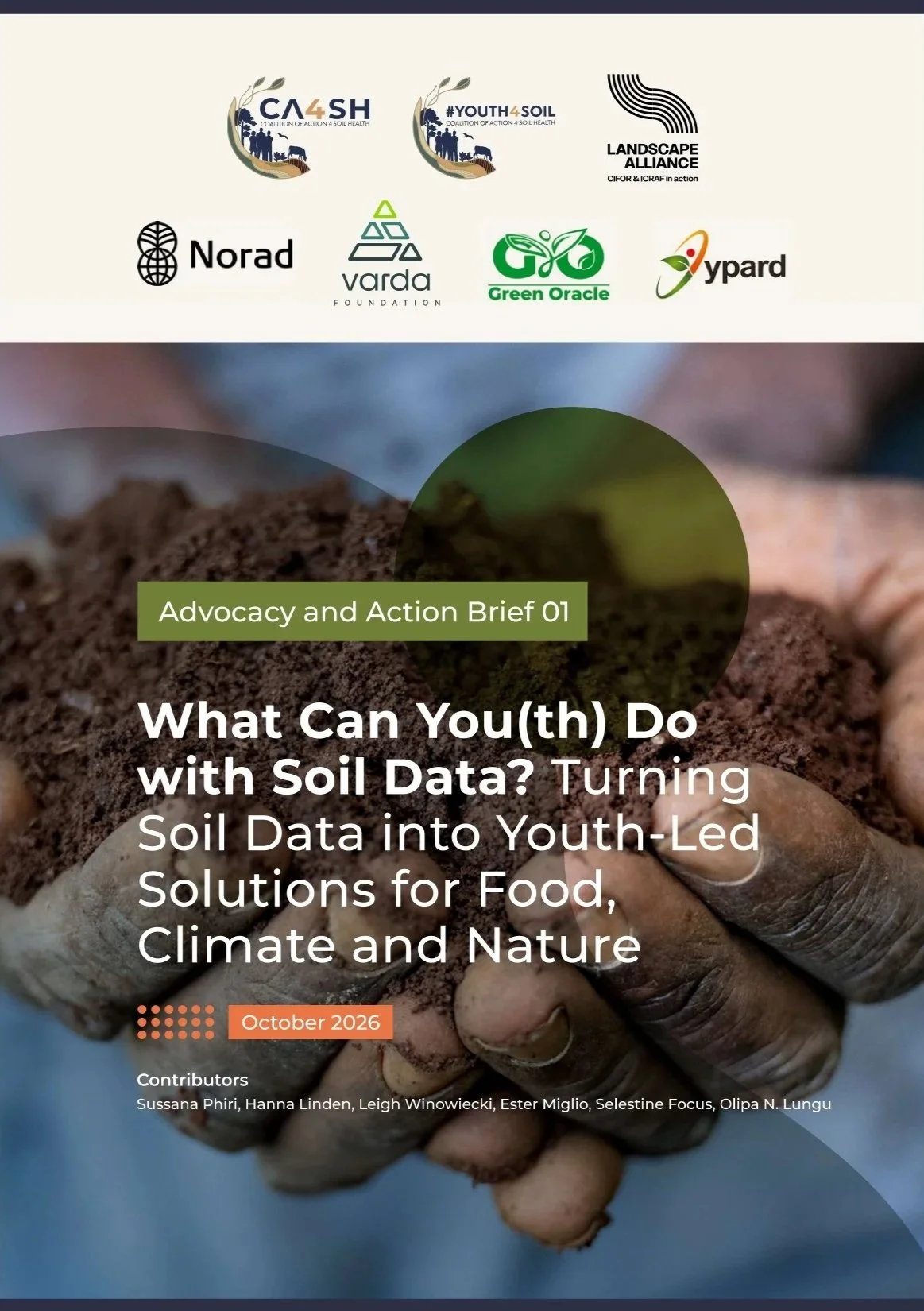
What Can You(th) Do with Soil Data? Turning Soil Data into Youth‑Led Solutions for Food, Climate and Nature
Healthy soil underpins food security, climate resilience, ecosystem restoration, and livelihoods. Yet more than one‑third of the Earth’s surface is degraded, undermining soil’s ability to sustain life. Soil health data is a critical tool to reverse this trend through evidence‑based decision making, but it remains fragmented, hard to understand, and often inaccessible to those who need it most — especially young practitioners, professionals, and advocates. This brief highlights how demystifying soil data can empower youth to lead solutions for food, climate, and ecosystems with four key messages:
Soil data must be democratized
Accessible, usable soil data is essential for youth to design sustainable land management systems, advocate for inclusive policies, and innovate solutions that strengthen resilience.Youth bring unique perspectives
Digital fluency, cross‑disciplinary thinking, proximity to communities, and strong communication skills position young people to translate soil data into action, innovation, and advocacy.Pathways for engagement
From research and technical roles to policy advocacy, entrepreneurship, and community mobilization, soil data offers diverse entry points for youth to drive evidence‑based restoration and sustainable agrifood systems.Co‑creation and equity
Policies and initiatives must not only consult youth but create opportunities for meaningful engagement, ensuring inclusion of young women, indigenous youth, pastoralists, and marginalized communities.
Soil data is a pathway to evidence‑based restoration, sustainability, and resilience. When demystified and linked to livelihoods, it empowers young people to innovate, advocate, and lead restoration efforts that strengthen food systems, protect ecosystems, and build climate resilience. For this potential to be realized, policies and investments must move beyond consultation to genuine co‑creation, ensuring youth — especially young women, indigenous communities, pastoralists, and marginalized groups — have the resources and platforms to act. By centering youth leadership, soil data becomes not only a technical tool but a catalyst for inclusive transformation at local, national, and global levels.

Enhancing access to and use of reliable soil information through an interoperable soil data infrastructure: A review of existing soil health initiatives and data in Ghana, Kenya, Malawi and Tanzania
Soil health information is a critical tool for identifying intervention areas to reverse land degradation, providing tailored fertilizer recommendations, and supporting policy processes, among myriad other benefits. Multistakeholder actors in Africa are already collecting data and sharing them with their wider networks, but many of these data sharing systems are limited in scope, cumbersome or locked behind institutional barriers. Fostering collaborative soil knowledge exchange could bolster the uptake of soil health data to drive evidence-based action on behalf of food systems, the environment, and people. Despite new continental momentum toward scaling soil health supported by data, there is limited stocktaking or documented baselines on current initiatives toward scaling soil health. This review seeks to address this gap and support the consolidation of efforts and initiatives at continental and national levels.
The results of this review can help prioritize and streamline efforts to build a collaborative soil data sharing community toward enhanced action in Africa under the Norad-funded initiative, Establishing an ecosystem of soil data-driven services.

Restoring Rangelands from the Soil Up: Soil Health as the Foundation of Inclusive Land Restoration
This brief presents:
The evidence base for soil health as a key indicator of rangeland restoration, resulting from improved and inclusive land governance which is foundational to rangelands restoration.
Priority actions for key stakeholders.
Contributions to the implementation of Decision 29/COP.16 on rangelands and pastoralists, Decision 19/COP.16 on agricultural lands, and the Rangelands Flagship Initiative to be launched at COP17.
Key Messages for COP17:

How Healthy Soil Aligns the Rio Conventions and Global Agendas
This knowledge product demonstrates how soil health serves as a unifying foundation across the three Rio Conventions—the United Nations Convention to Combat Desertification (UNCCD), the Convention on Biological Diversity (CBD), and the United Nations Framework Convention on Climate Change (UNFCCC)—while contributing to the achievement of the Sustainable Development Goals (SDGs). It reviews the key policy mechanisms under each Convention and identifies opportunities to strengthen the integration of soil health into national implementation, monitoring, and reporting processes.

From Soil Data to Action: The Role of Soil Information Systems for the Rio Conventions
This policy brief outlines the case for policymakers to scale SISs and integrate monitoring of SOC in national reporting towards the goals of the Rio Conventions. It explores the context and need for advancing SISs to support voluntary targets laid out in national LDN, NBSAPs, and NCDs.

CA4SH 2025 Annual Report
CA4SH is now a multistakeholder Coalition of over 350 diverse organizations and individuals working together to scale global soil health through collective action. As the Coalition has grown over the years, so too has the need to adapt and refine our strategy to engage effectively with our partners.
2025 was marked by this spirit of continual learning, which we are operationalizing through an updated strategic framework. Key to the success of this model is strategic engagement in diverse fora, and in 2025, we did just that; CA4SH had a strong presence at global, national and regional events and has launched several unique initiatives to engage in these processes. For example, in 2025, we played a role in streamlining soil health in the Comprehensive African Agriculture Development Programme (CAADP) by engaging at the CAADP Partnership Platform in Kigali, Rwanda, and we launched a new joint initiative for establishing an ecosystem of soil data driven services in four African countries to support the CAADP implementation. Underpinning all of our work is youth engagement, and several youth partner initiatives engaged in these processes and implemented unique, context-specific projects on the ground.
CA4SH will celebrate its fifth anniversary in 2026, and we have much to look back on and learn from to chart the next five years and beyond.

Project Inception Workshop Report: Establishing an ecosystem of soil data-driven services to meet the Global Fertiliser and Soil Health Challenge
In 2024, CIFOR-ICRAF and Varda Foundation piloted a soil knowledge exchange initiative in Kenya and Tanzania, funded by the Norwegian Agency for Development Cooperation (NORAD). The pilot focused on identifying barriers and opportunities for building a collaborative soil data ecosystem and directly shaped the project's design.
Building on the pilot initiative, CIFOR-ICRAF and the Varda Foundation, with support from NORAD, are now launching a new three-year initiative to create a dynamic ecosystem of soil data-driven services across Kenya, Ghana, Malawi, and Tanzania.
From 27 - 28 January 2026, the project consortium met at the CIFOR-ICRAF office in Nairobi for a project inception meeting.

Malawi Stakeholder Workshop Report: Establishing an ecosystem of soil data-driven services
The World Agroforestry (ICRAF) and Varda Foundation organised a one-day stakeholder consultation workshop in Malawi on 10th December 2025. The workshop aimed to bring together key partners to understand the soil health ecosystem in Malawi, including mapping existing soil health initiatives in the country, identifying and prioritizing use cases for soil health data and introduce the Soil Hive Platform. The workshops brought together a diverse range of stakeholders from across Malawi with over 30 participants attending the workshop. Participants included representatives from Government ministries e.g. the ministry of agriculture, research, academia, NGOs, youth organisations including Young Professionals for Agricultural Development (YPARD). Department of Agricultural Research Services, the national agriculture research institute in Malawi was also represented.