
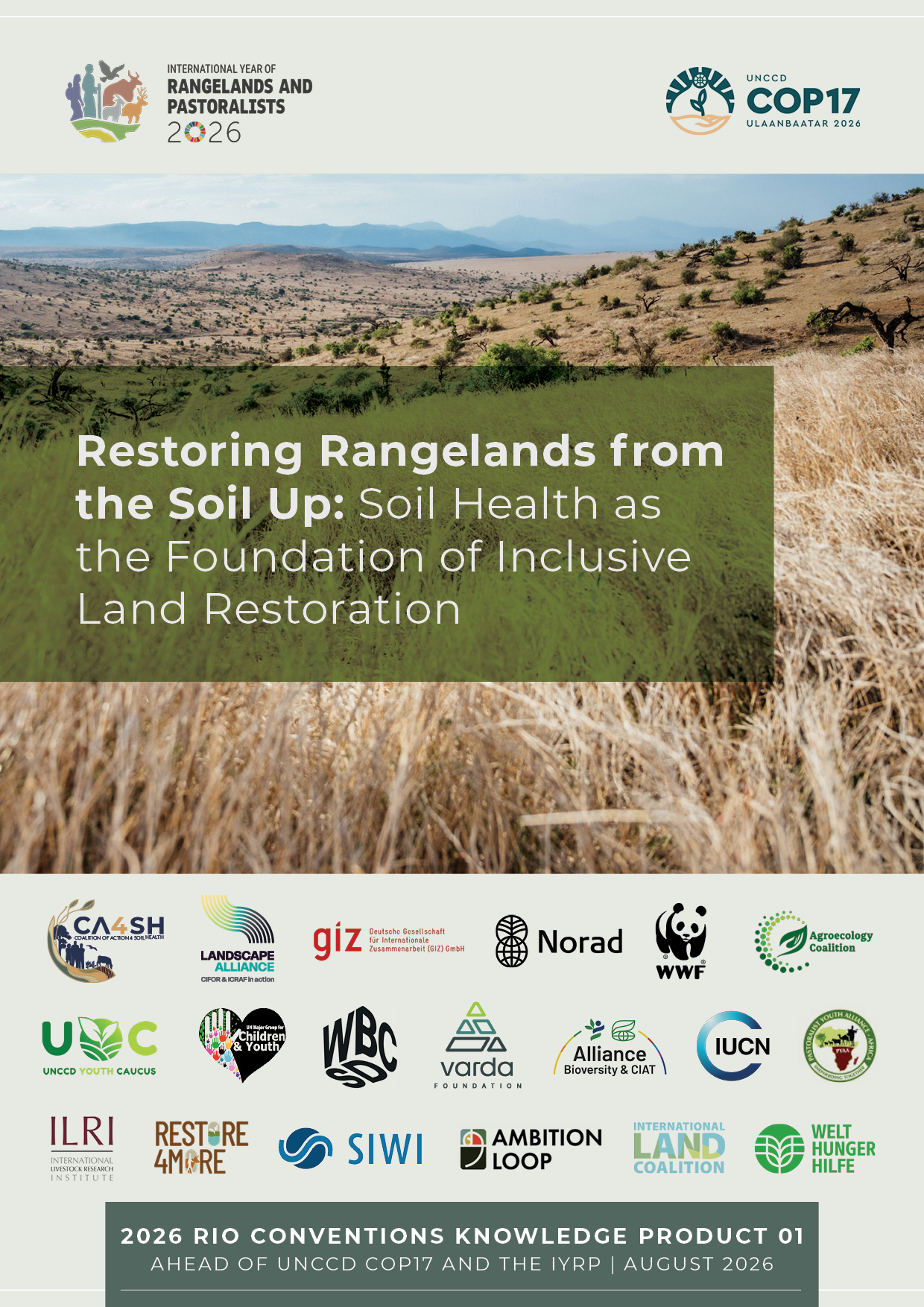
Restoring Rangelands from the Soil Up: Soil Health as the Foundation of Inclusive Land Restoration
Healthy soil underpins global food and nutrition security, with 95% of food production depending on soil resources. It is also central to ecosystem restoration, climate change mitigation and adaptation, biodiversity protection, water security and resilient livelihoods. Rangelands, which cover more than half of the Earth’s surface and support the direct livelihoods of an estimated 500 million people, are among the ecosystems where soil health is most critical and most neglected. Yet as much as 50 per cent of rangelands are degraded, threatening food systems productivity, pastoral livelihoods, and community resilience worldwide. While it is often framed that rangelands support pastoralists, pastoralists support rangelands; through their careful and intelligent grazing of animals, especially through mobile systems, pastoralists also help maintain and improve soil health, including improving soil fertility, microbiodiversity, and micro-climate, improving its carbon sequestration potential, enhancing biodiversity and protecting against wildfires. Much of rangeland degradation can be attributed to the widespread undermining of these traditional land use practices that have shaped rangeland landscapes for millenia.
As the International Year of Rangelands and Pastoralists (IYRP 2026) unfolds and momentum builds toward United Nations Convention to Combat Desertification (UNCCD) COP17 in Mongolia, there is a strategic opportunity to place soil health at the centre of rangeland restoration efforts and to scale approaches that enhance soil-related ecosystem services, climate resilience, and sustainable livelihoods. This restoration must be grounded in the pastoralist practices and rangeland governance of the people who have not just stewarded these landscapes for generations, but who have helped sustain and restore them.
Maximising impact requires both better use of existing soil data and investment in new data collection to track changes over time. Soil data must support evidence-based decision making and ensure that farmers, pastoralists, rangeland communities, researchers, and policymakers benefit from available knowledge. For example, credible and effective outcome-based finance mechanisms rely on robust carbon monitoring, reporting and verification systems. Alongside scientific systems, Indigenous and community-based systems offer contextually grounded, temporally stable signals of ecosystem health that must be recognised as co-equal evidence, in rangeland monitoring and governance.
This brief presents:
The evidence base for soil health as a key indicator of rangeland restoration, resulting from improved and inclusive land governance which is foundational to rangelands restoration.
Priority actions for key stakeholders.
Contributions to the implementation of Decision 29/COP.16 on rangelands and pastoralists, Decision 19/COP.16 on agricultural lands, and the Rangelands Flagship Initiative to be launched at COP17.
Key Messages for COP17:
Integrate soil health into global and national climate, biodiversity, landscape restoration, and food commitments including NDCs, NAPs, NBSAPs, LDN targets, restoration goals, and national food systems pathways, with rangeland-specific indicators explicitly included.
Harmonise and strengthen soil information systems at the global, regional, and national levels to fulfill commitments, ensuring they are relevant to diverse contexts, supported with concrete use cases, accessible to stakeholders, actionable for decision making, and reflect diverse knowledge systems, recognising Indigenous and community-based indicators as co-equal alongside scientific metrics.
Strengthen policy incentives and public investments that enable regenerative agriculture and integrated farming and livestock systems to incentivise structures and regulations that reward long-term stewardship, not one-off adoption to prevent backsliding.
Ensure legal recognition of customary and communal land governance—recognising pastoral mobility as a legitimate, legally protected land management and restoration practice, not an absence of management.
Explicitly link rangelands restoration and soil health initiatives to tenure security - recognising that tenure security enables and sustains adaptive and restorative land use practices.
Invest in open, interoperable, and fit-for-purpose soil data infrastructure that enables accessible, reliable, and actionable soil information for decision making.
Empower farmers, pastoralists, rangeland communities, youth, women, and Indigenous Peoples as leaders and decision-makers in rangeland stewardship and restoration.