Mechanization | Beating time poverty of rural women in Ethiopia as enabler for equitable development
The gender dimension of mechanized agricultural services
Women suffer disproportionally from time poverty, often spending 16 h a day working. This severely limits their possibilities to participate in capacity building (reach) or to implement measures (benefit) as well as their ability to participate and advocate in decision-making processes (empower).
An anthropological study revealed that farm work such as planting, processing, threshing/shelling and weeding consume much of their time. Also fetching water is a huge challenge. Women headed households are also unable to plough their fields without support by male relative and are therefore often disowned of their property or its economic use. Moreover, unequal access to resources exacerbates these challenges, hindering women from realizing their full potential in the agricultural sector.
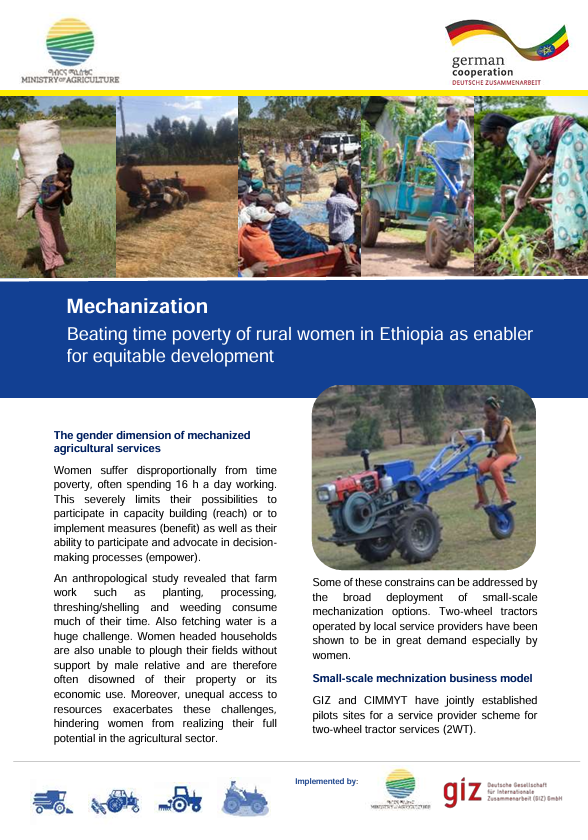
Some of these constrains can be addressed by the broad deployment of small-scale mechanization options. Two-wheel tractors operated by local service providers have been shown to be in great demand especially by women.