Resource Library
Any CA4SH partner can submit a resource to the Library, where we hope to increase visibility of diverse work related to improving soil health globally.
Please send a web link or a file to communications@coalitionforsoilhealth.org if you would like to submit a resource.
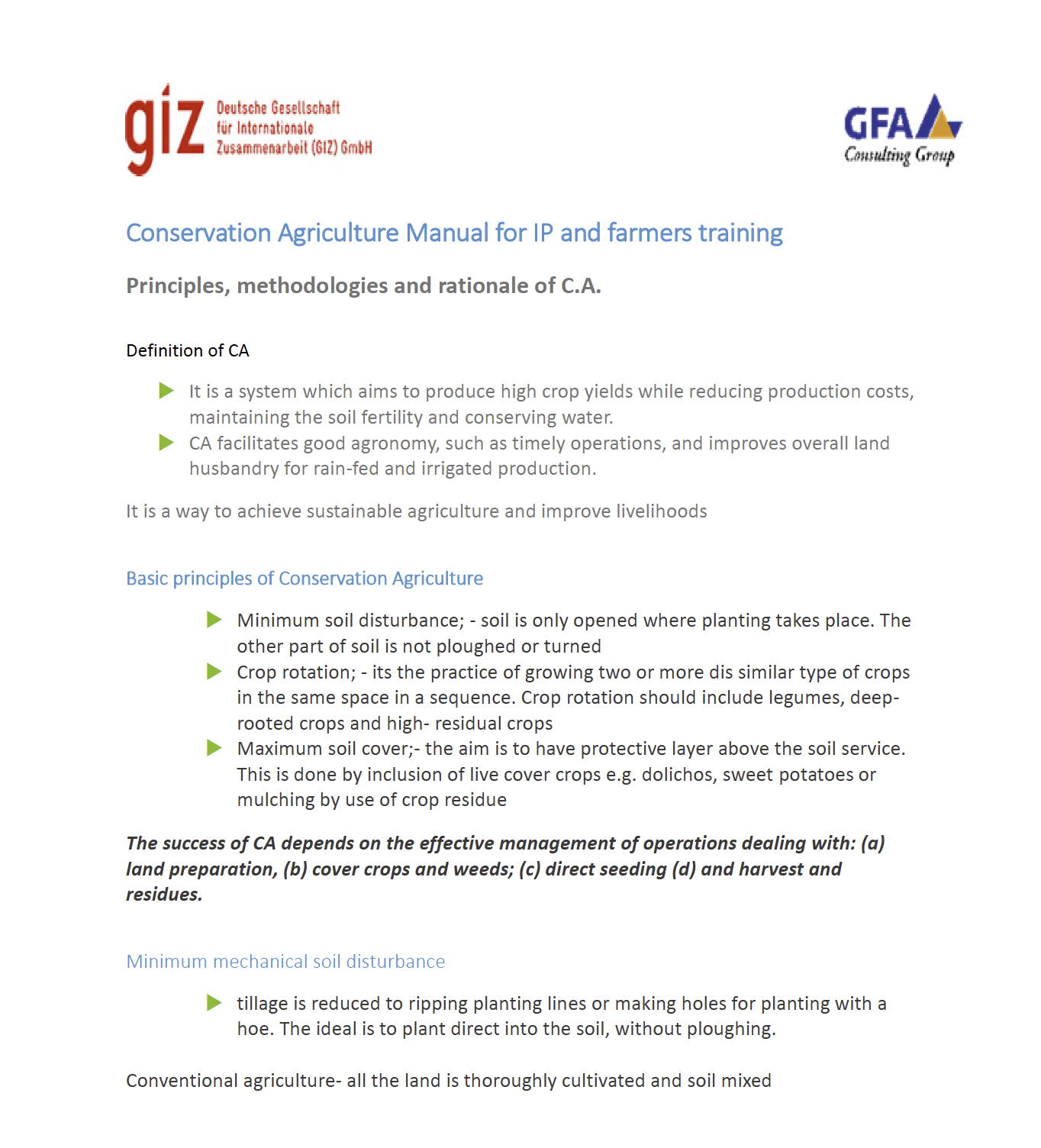
Conservation Agriculture Manual for IP and farmers training - Kenya
Conservation Agriculture is a system which aims to produce high crop yields while reducing production costs, maintaining the soil fertility and conserving water. CA facilitates good agronomy, such as timely operations, and improves overall land husbandry for rain-fed and irrigated production. It is a way to achieve sustainable agriculture and improve livelihoods.

Soil health and crop nutrient management: Building resilience and increasing the efficiency of nutrient application
Soil health is fundamental for the productivity of cropping systems. It relies on three interlinked pillars: (1) availability of sufficient nutrients, (2) organic matter and (3) soil biota. Organic matter regulates pH and supports nutrient availability, water retention and soil biodiversity. Soil biotas decompose organic matter and improve soil structure by forming soil aggregates.

Fields of Harmony: Pulses and Sustainable Land Management
This compilation consists of ten selected SLM practices that contribute to improved soil fertility and enhance soil health for the sustainability of food and agricultural systems.

Sustainable Use of Rehabilitated Land for Economic Development Programme Technical Manual: Soil Fertility Management
This “Soil Fertility Management” technical manual is designed as a training package targeted to reach communities. The manual consists and provides technical information and theoretical backgrounds for “Integrated Soil Fertility Management” (ISFM) technologies for woreda experts and Development Agents for use as a teaching and learning aid.
The manual is available at GIZ-SURED programme offices or as free download from the Ministry of Agriculture website. An additional manual developed by the SURED programme “Training Manual for Biological Soil and Water Conservation” provides additional and complementary information.

Field Guide Technical Implementation: Integrated Soil Fertility Management
The Guide is designed to firstly raise awareness among farmers about soil fertility problems, secondly, how different measures can be used in an integrated approach, and thirdly, how to try, monitoring and evaluating different practices. Understanding the key physical and biological features of soils is essential for developing sustainable improvement strategies. Helping farmers to gain and improve their knowledge will enable them to make conscious choices for how to manage their soils, their crops and their livestock.

Le Biochar et al Terra Preta pour une Agriculture Durable au Benin: Quatre Ans d’Experience et de Mise en Oeuvre par ProSol Benin
Au Bénin, les sols s’épuisent à un rythme accéléré du fait des mauvaises pratiques culturales, des conditions climatiques et de l’utilisation abusive des engrais minéraux. Une étude faite en 2016 sur le niveau de fertilité des sols par le Laboratoire d’Appui à l’Amélioration de la Santé des Sols, de la qualité des Eaux et à la sauvegarde de l’Environnement (L2A2S2E) de l’Institut National des Recherches Agricoles du Bénin (INRAB) a révélé que 90 % des sols du Bénin ont un niveau de fertilité faible à très faible, notamment dans les départements du Borgou, de l’Alibori et du Zou. Cela entraine des conséquences telles que la diminution des rendements des cultures, la menace à la sécurité alimentaire, l’augmentation de la pauvreté ainsi que la menace à l’environnement et à la santé humaine.
Pour inverser cette situation, le projet « Protection et Réhabilitation des Sols (ProSOL) » promeut la mise en œuvre à large échelle des approches de protection et de réhabilitation durables des sols au Bénin. Le biochar, la Terra Preta et le compost sont des innovations parmi les mesures de Gestion Durable des Terres (GDT) diffusées par ProSOL.

Émissions de gaz à effet deserre de différents concepts de production de compost à Madagascar
Le carbone, qui a été produit à partir du compost et dont la durée de vie est liée durable, contribue à réduire la quantité de CO2 qui a été produite lors de l'épuisement de la biomasse utilisée et qui a été produite à partir du compost.
Les processus de compostage et l'application de compost aux sols agricoles interagissent avec l'environnement et le système climatique de multiples façons complexes, ce qui entraîne de nombreuses incertitudes.
Afin de réduire ces incertitudes à l'avenir et d'accroître la robustesse des résultats comptables, des mesures des valeurs d'émission réelles ou du carbone séquestré devraient être effectuées régulièrement au cours de la mise en œuvre et de l'exploitation des technologies étudiées en Madagascar.

Les Mesures D'Adaptation aux Effets du Changement Climatique (Mesures ACC) Promues par le ProSol Benin
Le Bénin à l'instar d'autres pays en Afrique, est dans une dynamique de lutte contre les effets du changement climatique à travers l'établissement d'un cadre de gouvernance et des mécanismes de coordination institutionnelle (CNCC. MCVDD, CMEICB, FNEC, CTPNA, etc.) ainsi que l'adoption de politiques/stratégies opérationnalisées par la mise en œuvre de projets et de programmes. Ces mesures permettront de rendre la production agricole résiliente aux effets du changement climatique afin de garantir la sécurité alimentaire. L'intervention du ProSOL sur la Gestion Durable des Terres et l'Adaptation au Changement Climatique (GDT/ACC) promues dans ses zones d'intervention vient dès lors à point nommé pour contribuer à cette dynamique déjà en cours au Bénin.

2024 Annual Report | Center for Rural Empowerment and Agricultural Transformation for Sustainability (Creats International)
Presenting the 2024 Annual Report of the Center for Rural Empowerment and Agricultural Transformation for Sustainability (Creats International). Through your generous donations, strong partnerships, and unwavering support, we achieved remarkable milestones captured in this report.
As we celebrate ten years since our founding, we extend our heartfelt gratitude for walking with us on this transformative journey. Together, we look forward to deepening our impact and continuing to empower communities to move from merely surviving to truly thriving.

Policy Brief | Healthy Soils, Resilient Systems: Levers for Sustainable Agricultural and Food Systems
This Policy Brief derives from the “Partners for Change – SOILutions for a Food Secure, Resilient, and Sustainable Future” (short SOILutions) conference in May 2025. The Partners for Change (P4C) Network brings together around 250 key stakeholders from government, civil society, and the private sector from over 30 countries. To advance the transformation of agricultural and food systems, the P4C Network provides an inclusive dialogue platform that fosters the c ocreation of sustainable transformation pathways across the three stakeholder groups.

Policy Pathway Brief | Promoting Water Security and Resilience in Water Systems in Agriculture
This Brief focuses on the interactions between water security, resilient freshwater systems and agricultural practices and land use. It identifies policy instruments and actions for governments to provide incentives and support to water users in agriculture to manage the quantity and quality of water sourced, used and discharged in a more sustainable way. This can boost water security and resilience of freshwater systems more broadly while strengthening the resilience of agricultural production and food security.

Youth Initiatives for Scaling Soil Health: Advice from #Youth4Soil Global Advocates
The Coalition of Action 4 Soil Health (CA4SH) is a multistakeholder partnership committed to scaling soil health, globally. CA4SH places a high degree of importance on the role of youth as innovators and experts toward scaling global soil health. Youth are engaged through the #Youth4Soil movement, which includes a working group, mentorship opportunities, and support for speaking and engagement. We also want to highlight youth approaches to advocating for global soil health.
In April 2024, Roël D. Houdanon, Founder & Chief Technical Advisor, Land and Health Association shared an op-ed highlighting the role of youth in defending soil health. He presented several avenues for youth to get involved in scaling soil health:
Awareness Raising
Innovation & Technology
Policy Advocacy
Community Engagement
Education
Science & Research
We reached out to youth partners to learn about their individual approaches to scaling soil health through these thematic action areas.
These are their responses.

Healthy soils sustain foodsystem transformationsto contribute to the net zeroCO2emission target by 2050
Food system transformation is needed for "safeguarding food security and ending hunger, and the particular vulnerabilities of food production systems to adverse impact of climate change".
Read the full policy brief from 4p1000, CIRAD, and IRD

Payments for Ecosystems Services to Support Transitions to Sustainable Agriculture and Land Use
This brief focuses on Payments for Ecosystems or Environmental Services (PES) as a mechanism for providing incentives to land users to transition to more sustainable land management.
Agriculture and food systems are both drivers and victims of escalating climate and nature crises, in turn increasing the risks to healthy diets, livelihoods and economies. Public policies can set incentives for farming and market practices that further exacerbate these trends, but they can also play a role in reversing them. The global Agriculture Policy Dialogue on Transition to Sustainable Agriculture is a peer-to-peer platform to share experience, facilitate partnerships and catalyse policy leadership to accelerate the transition to sustainable agriculture and food systems that benefit people, prosperity and the planet.
Policy Pathway Briefs provide an overview of emerging experiences and lessons on policy approaches that contribute to this transition, covering a series of topics requested by Policy Dialogue members, to support peer leaning and knowledge exchange. The briefing notes are in no way exhaustive. The options facing governments will be context specific and look different across and within countries. The notes aim to act as a discussion starter and to facilitate exchanges between countries engaged in the Agriculture Policy Dialogue and with other global initiatives, drawing on the experiences presented by members and examples identified through further research.

Promoting Healthy Soils and Land
This brief focuses on soil health, identifying policy instruments and actions for governments to provide incentives and support to farmers to protect and restore agricultural soils.
Agriculture and food systems are both drivers and victims of escalating climate and nature crises, in turn increasing the risks to healthy diets, livelihoods and economies. Public policies can set incentives for farming and market practices that further exacerbate these trends, but they can also play a role in reversing them. The global Agriculture Policy Dialogue on Transition to Sustainable Agriculture is a peer-to-peer platform to share experience, facilitate partnerships and catalyse policy leadership to accelerate the transition to sustainable agriculture and food systems that benefit people, prosperity and the planet.
Policy Pathway Briefs provide an overview of emerging experiences and lessons on policy approaches that contribute to this transition, covering a series of topics requested by Policy Dialogue members, to support peer leaning and knowledge exchange. The briefing notes are in no way exhaustive. The options facing governments will be context specific and look different across and within countries. The notes aim to act as a discussion starter and to facilitate exchanges between countries engaged in the Agriculture Policy Dialogue and with other global initiatives, drawing on the experiences presented by members and examples identified through further research.

Promoting Efficient Use and Greener Production of Fertilizers
This brief focuses on fertilizers and provides guidance on policy actions that can incentivize efficient and more sustainable use and production of synthetic fertilizers.
Agriculture and food systems are both drivers and victims of escalating climate and nature crises, in turn increasing the risks to healthy diets, livelihoods and economies. Public policies can set incentives for farming and market practices that further exacerbate these trends, but they can also play a role in reversing them. The global Agriculture Policy Dialogue on Transition to Sustainable Agriculture is a peer-to-peer platform to share experience, facilitate partnerships and catalyse policy leadership to accelerate the transition to sustainable agriculture and food systems that benefit people, prosperity and the planet.
Policy Pathway Briefs provide an overview of emerging experiences and lessons on policy approaches that contribute to this transition, covering a series of topics requested by Policy Dialogue members, to support peer leaning and knowledge exchange. The briefing notes are in no way exhaustive. The options facing governments will be context specific and look different across and within countries. The notes aim to act as a discussion starter and to facilitate exchanges between countries engaged in the Agriculture Policy Dialogue and with other global initiatives, drawing on the experiences presented by members and examples identified through further research.
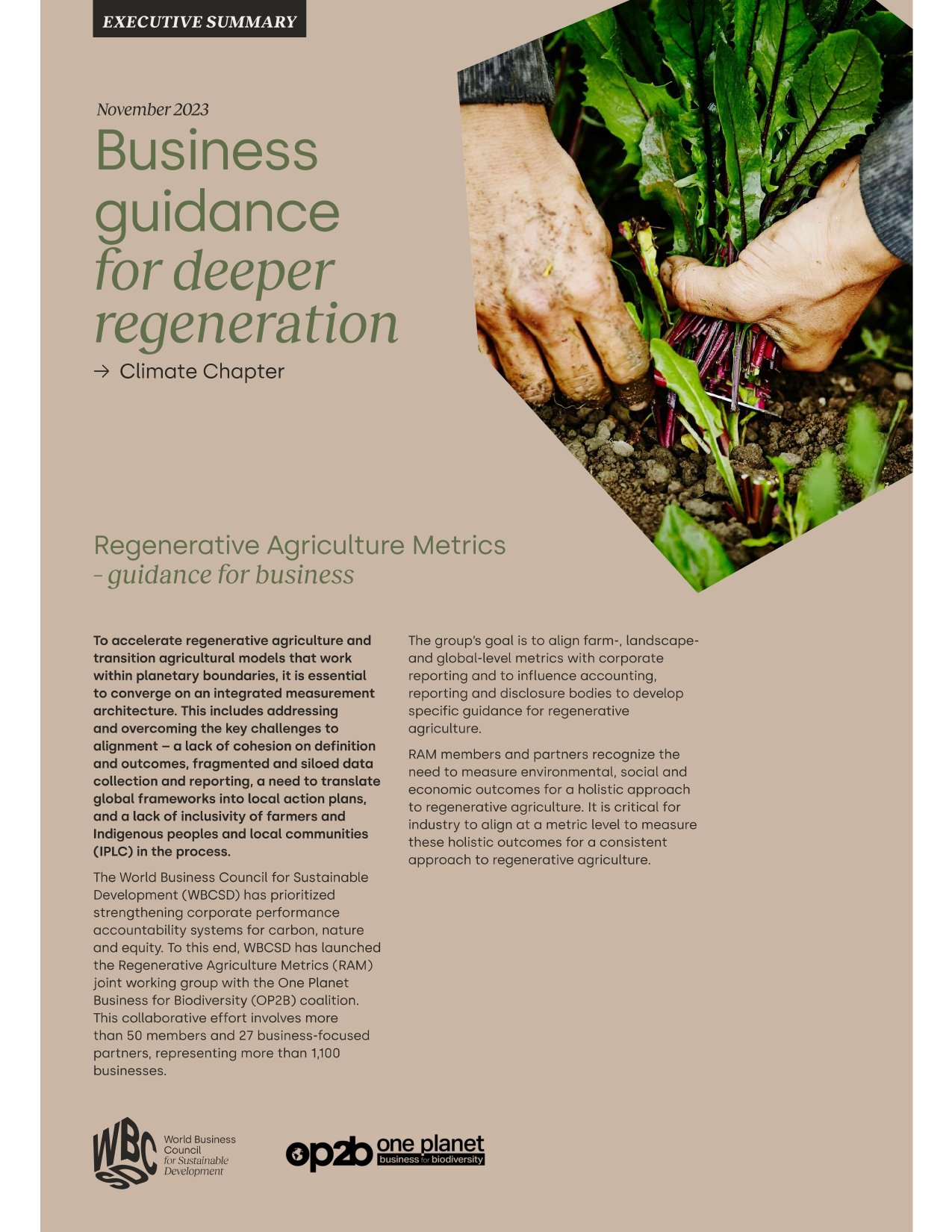
Regenerative Agriculture Metrics: Guidance for Business
To accelerate regenerative agriculture and transition agricultural models that work within planetary boundaries, it is essential to converge on an integrated measurement architecture. This includes addressing and overcoming the key challenges to alignment – a lack of cohesion on definition and outcomes, fragmented and siloed data collection and reporting, a need to translate global frameworks into local action plans, and a lack of inclusivity of farmers and Indigenous peoples and local communities (IPLC) in the process.
The World Business Council for Sustainable Development (WBCSD) has prioritized strengthening corporate performance accountability systems for carbon, nature and equity. To this end, WBCSD has launched the Regenerative Agriculture Metrics (RAM) joint working group with the One Planet Business for Biodiversity (OP2B) coalition. This collaborative effort involves more than 50 members and 27 business-focused partners, representing more than 1,100 businesses.

COP28 UAE Declaration on Sustainable Agriculture, Resilient Food Systems, and Climate Action
The COP28 Presidency today announced that 134 world leaders have signed up to its landmark agriculture, food and climate action declaration.
Download resources from the COP28 Presidency