2 December 2025 - At the twenty-third session of the Committee for the Review of the Implementation of the Convention (CRIC 23) of the United Nations Convention to Combat Desertification (UNCCD), in Panama City, Panama, young people from around the world gathered to explore how land, food systems, and climate resilience are deeply interconnected. Among the highlights was a keynote conversation with Dr. Barron Joseph Orr, Chief Scientist of the UNCCD, whose work has shaped global understanding of land degradation, drought resilience, and sustainable land management.
As countries face unprecedented droughts, floods, and food insecurity, Dr. Orr has been at the forefront of communicating a key truth: healthy soil is one of our most powerful, yet overlooked, solutions. His insights are rooted in science, but also in a deep commitment to ensuring young people understand their influence in shaping land-based solutions.
During the session “Youth Policy Pathways for Land and Food: Advancing Action on Land Degradation Neutrality”, Mahathi Aguvaveedi (UNCCD Youth Caucus) led the conversation with Dr. Orr, exploring why soil matters, how drought resilience really works, and what young people can do to advance sustainable land management. The conversation offers valuable guidance for anyone working at the intersection of land and food systems.
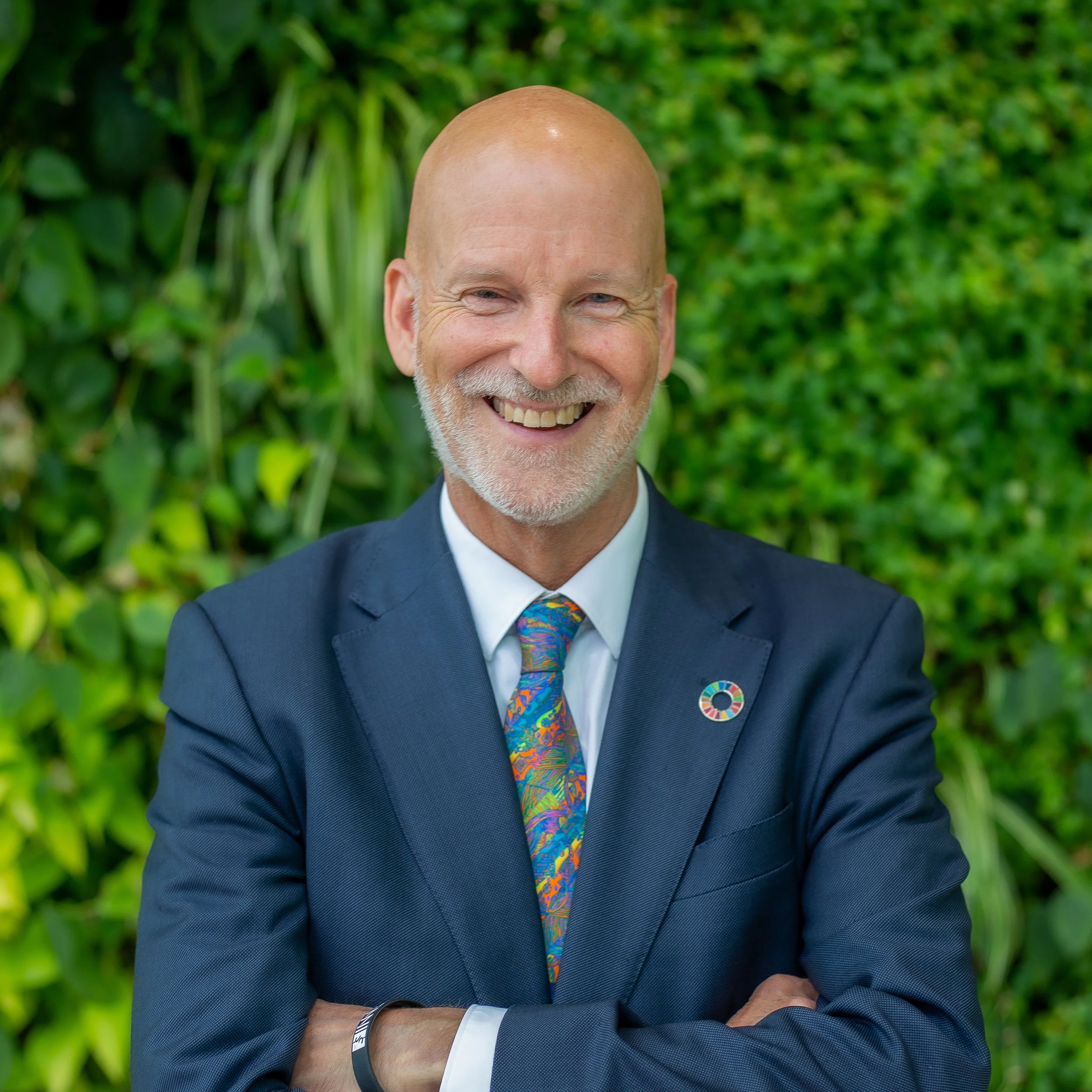
Barron Joseph Orr is the Chief Scientist for the United Nations Convention to Combat Desertification (UNCCD). He is Professor Emeritus at the University of Arizona (USA) where he also served as a NASA Geospatial Extension Specialist. As Profesor avalista at the University of Alicante (Spain), he helped develop a restoration ecology graduate degree. His career has been focused on coupled human and environmental systems undergoing environmental change and bridging the divides between science, policy, practice and society.
His work involving indigenous and local knowledge, participatory research, stakeholder engagement and user-centred design led to being named a Marie Curie Fellow as well as being selected as an independent scientist for the UNCCD Science-Policy Interface (SPI). After a career collaborating with local communities, he is now helping governments ensure that global policies on land and drought are evidenced based. He contributes scientifically to the development of global environmental monitoring frameworks, including one on SDG 15 “Life on Land” and another on drought resilience. He is also co-lead author of the Scientific Conceptual Framework on Land Degradation Neutrality (LDN) which was formally endorsed by the 197 Parties to the UNCCD in 2017. He obtained a doctorate in Arid Lands Resource Sciences from the University of Arizona and a Masters in International Affairs from Columbia University.
The following conversation has been edited for clarity and length.
We are seeing more floods and droughts than ever around the world. How would explain the importance of sustainable land management in addressing these impacts?
If we think about food, soil, water, drought, all these connected elements, the first step is to look at our own daily experience. When we hear about drought where we live, what are we told to do? What’s the number one message in TV or radio announcements?
Usually: “Use less water.”
But household water conservation is a tiny fraction of what would happen if we put biology back in the soil.
When soil organic matter increases, the soil’s water-holding capacity increases. That means water stays in the soil longer, and water productivity goes up, what Rattan Lal calls “more crop per drop.” If we scaled this everywhere, the effect would dwarf any amount of domestic water savings.
The second major measure is shifting away from thirsty crops toward varieties adapted to drier conditions.
These two actions, restoring organic matter and changing crop choices, do more for drought resilience than any other measures. Yet no one talks about them, and we rarely see policies that promote these changes. Most major impacts of drought today are tied directly to depleted soil water-holding capacity and thirsty crops.
There are thousands of practices to support this, but these two fundamentals are key.
You mentioned that these solutions rarely appear in public conversations. Why do you think soil hasn’t received the attention it deserves?
Because we don’t live there anymore. More than half of humanity now lives in cities. We’ve become disconnected from the land, and that disconnect extends to young people too.
Just recently at a joint youth session with UNCCD, UNFCCC, CBD, and the World Food Forum, I asked: “What are you doing to reach the vast majority of youth who have no idea this work is happening?” That has to be part of the programme.
If youth can figure out how to bring this message to a much larger percentage of their peers, governments will embrace it, because they also recognize the disconnect. And it’s reversible. If something becomes cool and meaningful, people respond.
So can we make this objective, soil, land stewardship, cool? That’s the challenge, and youth are the ones who know how to reach youth.
Many young people want to work with soil and land but don’t know where to begin. What skills or capacities should youth build early on to contribute meaningfully?
First, it depends on which youth you mean. Those who are already highly motivated, like many here, are innovators or early adopters in the “diffusion of innovation” curve. But the majority of young people aren’t going to study soil science. So we need different approaches for different groups.
For innovators: follow your interests. Technical skills like GIS are valuable, but your passion will drive the deepest impact.
For the early majority, the larger group, you need creative entry points. Many are into technology, software, or gaming. Why not meet them there?
For example, imagine a game where real-world sustainable actions, starting a school garden, working with local farmers, restoring a plot of land, actually earn points and help you level up. Years ago, Facebook had Farmville; imagine if it rewarded real sustainability actions. Something fun, less heavy on science but still grounded in it.
And there’s another piece I want to emphasize, because you’ll eventually ask this about not just youth, but everyone: People often say, “I’m not a farmer, what can I do about land degradation?”
What they wear, what they drink, what they eat for breakfast, almost certainly degraded land somewhere.
So I tell them: If you adjust just 5% of your purchases toward local products, preferably food, maybe clothing, you will do more for climate change, biodiversity loss, and land degradation than almost anything else.
Could we make that popular?
It’s simple. Everyone can relate to it. It doesn’t require complicated commitments.
I’ve even seen friends turn this into social media campaigns. You could do the same. If you embrace that idea, you’ve got me, I’m all in.