
Africa Food Systems Forum 2026
Africa Food Systems Forum is the world's premier forum for African agriculture and food systems, bringing together stakeholders to take practical action and share lessons that will move African food systems forward.
This year's AFS Forum, themed "Investing in Africa's Agri-Food Systems: Growing Jobs, Nourishing Nations, Building Resilience," marks a key milestone as Africa enters a new CAADP decade.
Date: 31 August – 4 September 2026
Venue: Kigali Conference Centre (KCC), Kigali, Rwanda
Soil Evidence for Smarter Subsidies
Date: 31 August 2026
Time: 13:30-14:30 (CAT)
Location: Innovation Hub Tent, Kigali Conference Centre
Healthy soils and resilient food systems cannot be achieved at scale without changing how public finance supports agriculture. The recent fertilizer price and supply shocks have further exposed the vulnerability of input-dependent production systems and the need to improve nutrient use efficiency and diversify nutrient resources. Too little investment reaches the farmers and communities restoring ecosystems and building long-term resilience. By linking soil information to public agricultural spending, governments can target support where it is most needed.
This session explores how robust soil evidence, perspectives from the field, and repurposed public agricultural support can inform policy, finance, and practice while advancing inclusive outcomes for all. Particular attention will be given to practical agronomic responses to Africa’s fertilizer crisis, including integrated soil fertility management, that strengthen resilience while reducing dependence on imported fertilizers.
Solutions Lab - Unlocking Carbon Finance for Sustainable Agriculture
Date: 1 September 2026
Time: 11:00-13:00 (CAT)
Location: MH2, Kigali Conference Centre
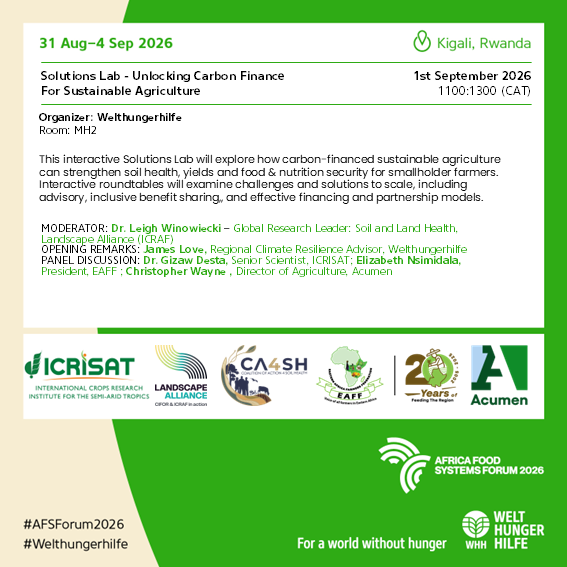
This interactive Solutions Lab will explore how carbon-financed conservation agriculture can strengthen soil health, yields and food & nutrition security for smallholder farmers. Interactive roundtables will examine challenges and solutions to scale, including advisory, inclusive benefit sharing, risk-management, transaction costs, and effective financing and partnership models. Participants from across the food systems, climate finance sectors will shape practical priorities, share feedback, build a value-aligned coalition, and identify commitments for action to unlock carbon finance for conservation agriculture at scale.
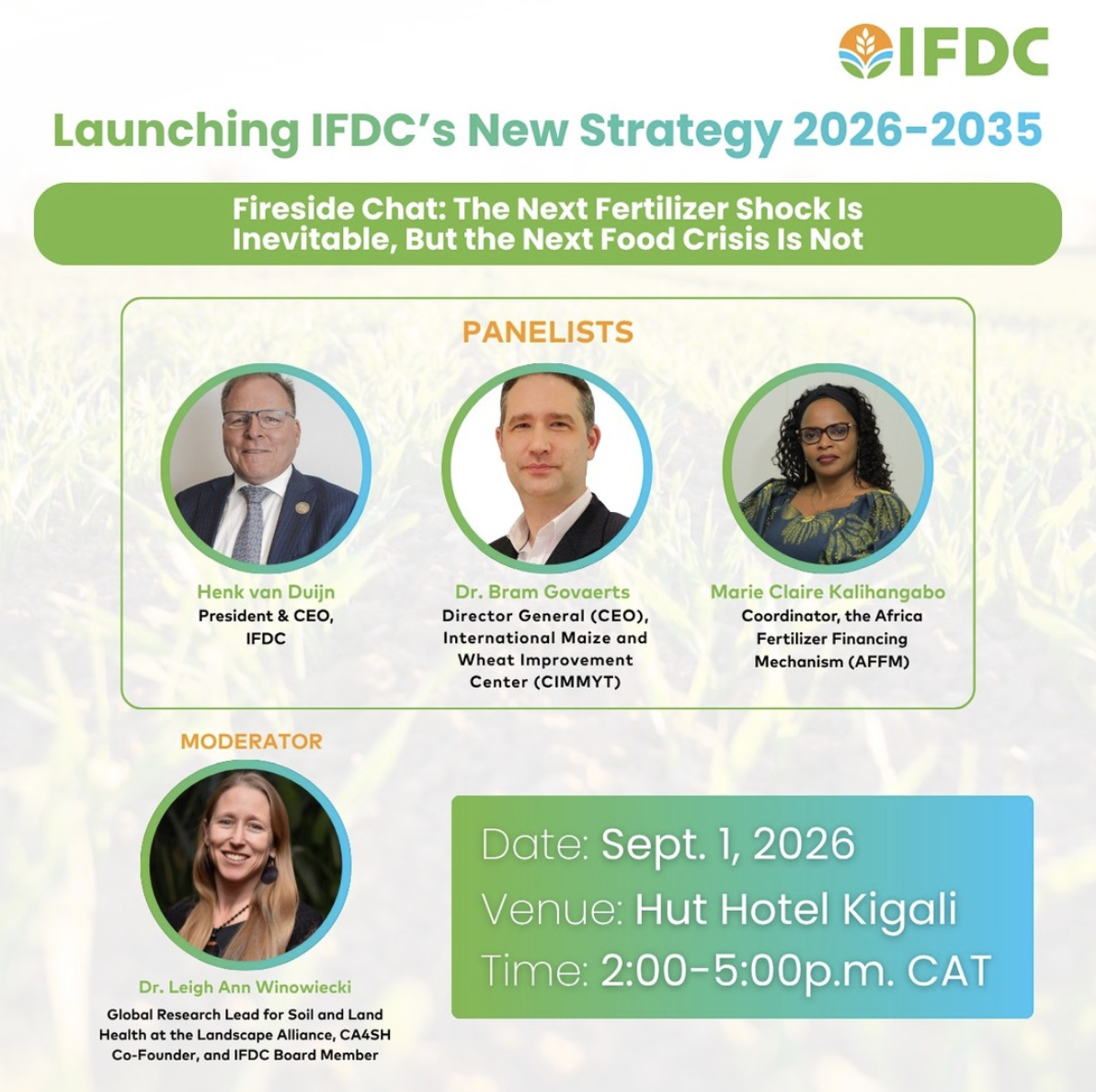
Launching IFDC’s New Strategy 2026-2035
Date: 1 September 2026
Time: 14:00-17:00 (CAT)
Location: Hut Hotel Kigali
The official launch of IFDC’s Strategy 2026-2035 highlights a renewed commitment to catalyzing innovative, market-driven solutions that improve soil health, boost productivity, and create more inclusive food systems for Africa’s future.
The event will host a fireside chat entitled, “The Next Fertilizer Shock Is Inevitable, but the Next Food Crisis Is Not.” Featuring IFDC President and CEO Henk van Duijn, International Maize and Wheat Improvement Center (CIMMYT) Director General and CEO Bram Govaerts, and Coordinator for the African Development Bank Group's Africa Fertilizer Financing Mechanism (AFFM) Marie Claire Kalihangabo, this panel will examine what makes fertilizer shocks so damaging and what it will take to prevent them from becoming full-blown food crises.
The discussion is expected to reinforce the strategic priorities at the heart of IFDC’s new Strategy 2026–2035 and highlight the importance of initiatives already underway with IFDC’s partners.
Sustainable Production Thematic Plenary – Surviving the Economy Shocks: Investing in Soil Health to absorb the Fertilizers crisis
Date: 2 September 2026
Time: 16:00-18:00 (CAT)
Location: Main Plenary Stage, Kigali Conference Centre
Soil health is the foundation of Africa’s food future. This plenary session will highlight how soil health evidence, youth-led innovation, inclusive investments, and aligned policies can drive the continent’s food systems transformation. With over 65% of Africa’s productive land degraded, and soil erosion being the most widespread form of land degradation, addressing soil health is urgent for food security, climate resilience, and rural livelihoods.
The collapse of Overseas Development Assistance will lead to a sharp spike in hunger, malnutrition and livelihood impoverishment on the African continent. ODA to sub-Saharan Africa fell 26% in 2025. Geopolitical shocks are repricing African agriculture: the Ukraine war drove fertiliser prices to historic highs; Strait of Hormuz tensions sent urea prices up significantly. The WFP projects 363 million people facing acute hunger across 53 countries. At the same time, soil degradation and the climate crisis increasingly risk derailing African food systems. Political, social, economic and environmental fragility will rise, particularly in critical nutrition security, land degradation, climate and biodiversity hotspots such as the Congo Basin, the Sahel zone and other regions in Sub-Saharan Africa.
This plenary session will be a high-level event (led by AUC, AU-NEPAD) that relates both to investments (theme of AFSF) and the geopolitical situation due to increase of fertilizer costs. The discussion can promote agroecology and regenerative agriculture to reduce the dependency of fertilizer imports. This includes using fertilizer more efficiently; gradually substituting mineral fertilizer with locally available organic resources such as manure, compost, and crop residues; investing in soil health by improving nutrient-use efficiency and strengthening soil organic matter; reducing the use of agrochemicals through integrated pest management; and diversifying farming systems.
Recognizing the pivotal role of healthy soils in sustainable agriculture, African leaders, private sector partners and key development partners will be held accountable to their pledge to enhance soil health and fertilizer use efficiency during the Fertilizer and Soil Health Summit (AFSH Summit) in Nairobi in May 2024. Progress update will be provided on the Africa Fertilizer and Soil Health Action Plan (AFSH-AP) and the Soil Initiative for Africa (SIA) that was endorsed at the AFSH Summit.