
Resource Library
Any CA4SH partner can submit a resource to the Library, where we hope to increase visibility of diverse work related to improving soil health globally.
Please send a web link or a file to communications@coalitionforsoilhealth.org if you would like to submit a resource.

Delivering nature-based solution outcomes by addressing policy, institutional, and monitoring gaps in forest and landscape restoration (Research Summary Brief)
Under the UK PACT funded project ‘Promoting nature-based solutions for land restoration while strengthening the national monitoring technical working group in Kenya’, CIFOR-ICRAF have undertaken practical training sessions with various stakeholders on using the Regreening App, a citizen science data collection initiative that enables farmers, government agents, project officers and implementors to track and provide evidence of restoration practices on the ground by reporting data on key indicators of land restoration.
This knowledge brief seeks to outline uptake of the Regreening Mobile App following two three-day practical workshops attended by a range of multi-disciplinary participants.

Evidence in Ecosystem Restoration: Insights and Recommendations
In light of the increased political support, international attention, and financial investment in restoration, the question this ‘Insight Brief’ aims to address is: How is evidence being used and integrated into (ecosystem) restoration processes and how can it be better utilised to inform and improve restoration action at scale? This brief seeks to highlight current issues around evidence in restoration with a view to providing input for future restoration projects and programmes under the UN Decade on Ecosystem Restoration, but also the diverse plans identified above.

Insight Brief: The Imperative for Strengthening Soil Information Systems in Africa: Reflections and Key Insights from Practice
African Heads of State and Government formally adopted the Africa Fertilizer and Soil Health (AFSH) Summit Declaration, also known as the Nairobi Declaration, during the AFSH Summit. The AFSH Summit addressed the urgent need to improve soil health and enhance fertilizer utilization across the continent to boost agricultural productivity and alleviate hunger and poverty. These priorities were initially identified in the 2006 Abuja Declaration on Fertilizer for the African Green Revolution.
Furthermore, the 2014 Malabo Declaration under the Comprehensive Africa Agriculture Development Program (CAADP) reaffirmed AU Member States' commitment to inclusive agricultural transformation, building on earlier initiatives such as the 2003 Maputo Declaration on CAADP and the 2004 Sirte Declaration on sustainable agriculture and water management. Despite these commitments, AU Member States have faced significant challenges in implementing the objectives outlined in these declarations.

Guidance Note - Advancing Africa's Soil Health Monitoring to Support the Nairobi Declaration and CAADP Kampala Agenda
To reverse Africa's interrelated challenges of land degradation, climate change, food security and biodiversity loss, African Union (AU) Member States will need to markedly increase the health of their soils and invest in soil restoration that is targeted and based on scientific evidence.
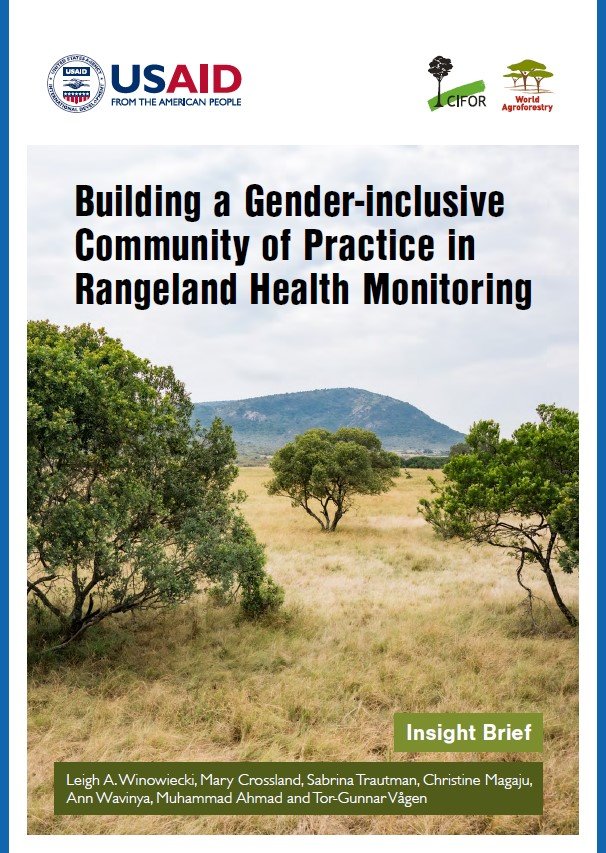
Building a Gender-inclusive Community of Practice in Rangeland Health Monitoring
This brief summarizes the capacity development activities undertaken by the project Restoration of Rangeland Carbon Sinks to build gender inclusive community of practice in rangeland health monitoring.
Specifically, the brief outlines the critical need to address gender inequalities in rangeland health monitoring and synthesises reflections from women and youth on skills they have built through capacity development activities. The brief also highlights the impact these activities are having not only in their own agency and development, but also the wider implications and impact they want to create in their communities as a result of the skills they have built and been exposed to.
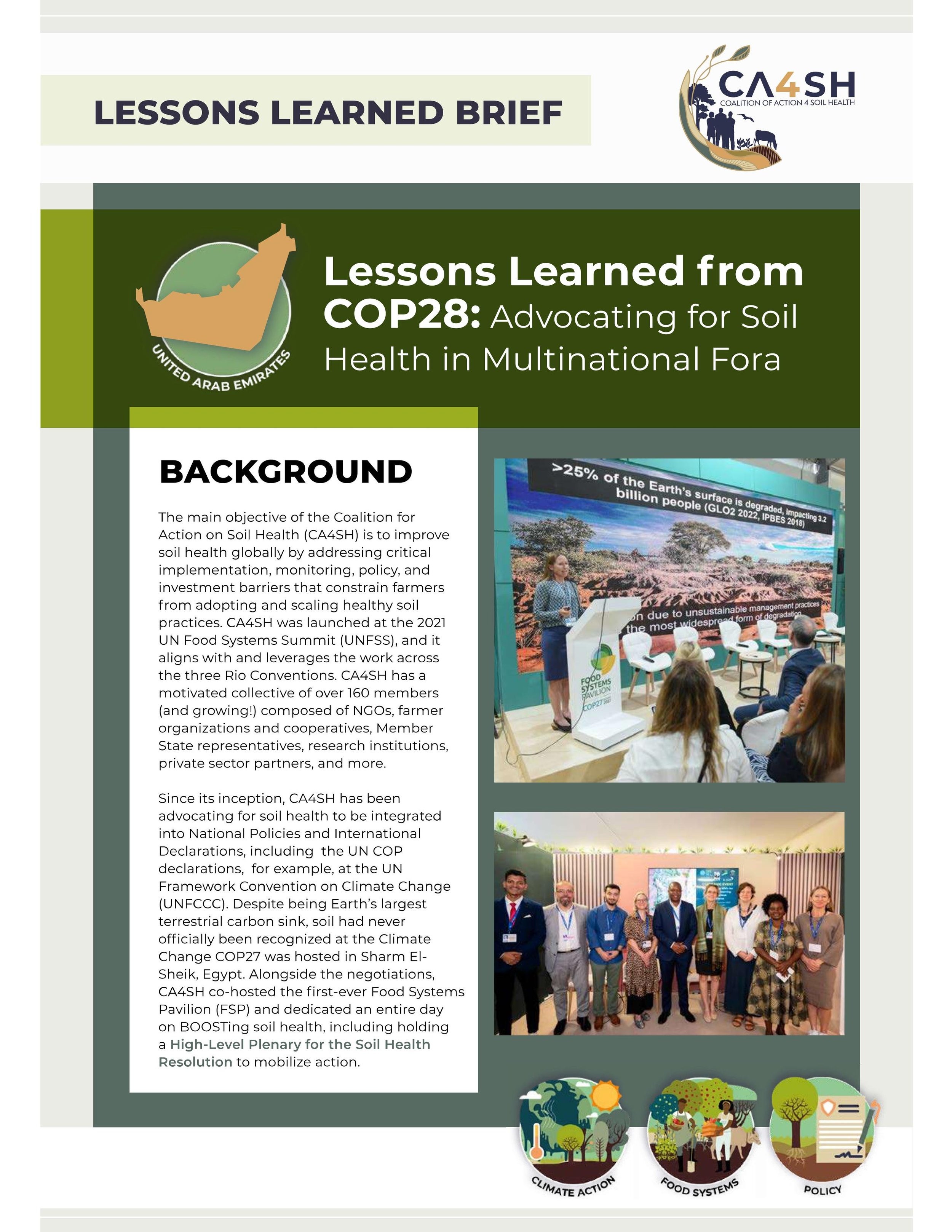
Lessons Learned from COP28: Advocating for Soil Health in Multinational Fora
Soil health was formally recognized in the COP28 UAE Declaration on Sustainable Agriculture, Resilient Food Systems, and Climate Action, in part because of the advocacy approach taken by CA4SH and our partners. In this brief, CA4SH partners and member states who engaged in this process lay out key lessons learned while advocating for soil in the context of the UNFCCC COPs, with recommendations for scaling this approach in other contexts.

Towards a definition of soil health
The Intergovernmental Technical Panel on Soils (ITPS) defines soil health as “the ability of the soil to sustain the productivity, diversity, and environmental services of terrestrial ecosystems”. In managed systems, soil health can be maintained, promoted or recovered through the implementation of sustainable soil management practices. As with human health, there is no single measure that captures all aspects of soil health. The preservation of these soil services requires avoiding and/or combating all types of soil degradation.

Best4Soil Community of Practice Video Library
Best4Soil is building a community of practice network across Europe by interconnecting growers, advisers, educators and researchers. Click to view their library of videos providing information on applying healthy soil practices.
Best4Soil Community of Practice Factsheets
Best4Soil is building a community of practice network across Europe by interconnecting growers, advisers, educators and researchers. Click to view their library of factsheets providing information on applying healthy soil practices.