
Resource Library
Any CA4SH partner can submit a resource to the Library, where we hope to increase visibility of diverse work related to improving soil health globally.
Please send a web link or a file to communications@coalitionforsoilhealth.org if you would like to submit a resource.
A Handbook on Composite Resource and Sustainable Soil Management Planning for Command Area Development
This handbook is prepared as a guiding manual for decision-makers, technical functionaries, field staff, and civil society working at local and district levels to contextualise best soil and water conservation methods for ensuring sustainable soil management, water conservation, and climate change mitigation. This Composite Resource Sustainable Soil Management (CRSSM) handbook, explains the rational of Sustainable Soil Management (SSM), focusses on enabling participatory and decentralized processes for planning, designing, and executing the SSM technology. It will also help field practitioners for improving the existing planning and financing mechanisms, building capacities, and strengthening cooperation between sectors, government departments, and all other implementing functionaries, and finally implementation of CRSSM. The idea of this handbook is to present CRSSM process in a manner which will be participatory, inclusive, climate-resilient, adaptive, and leaves no one behind.
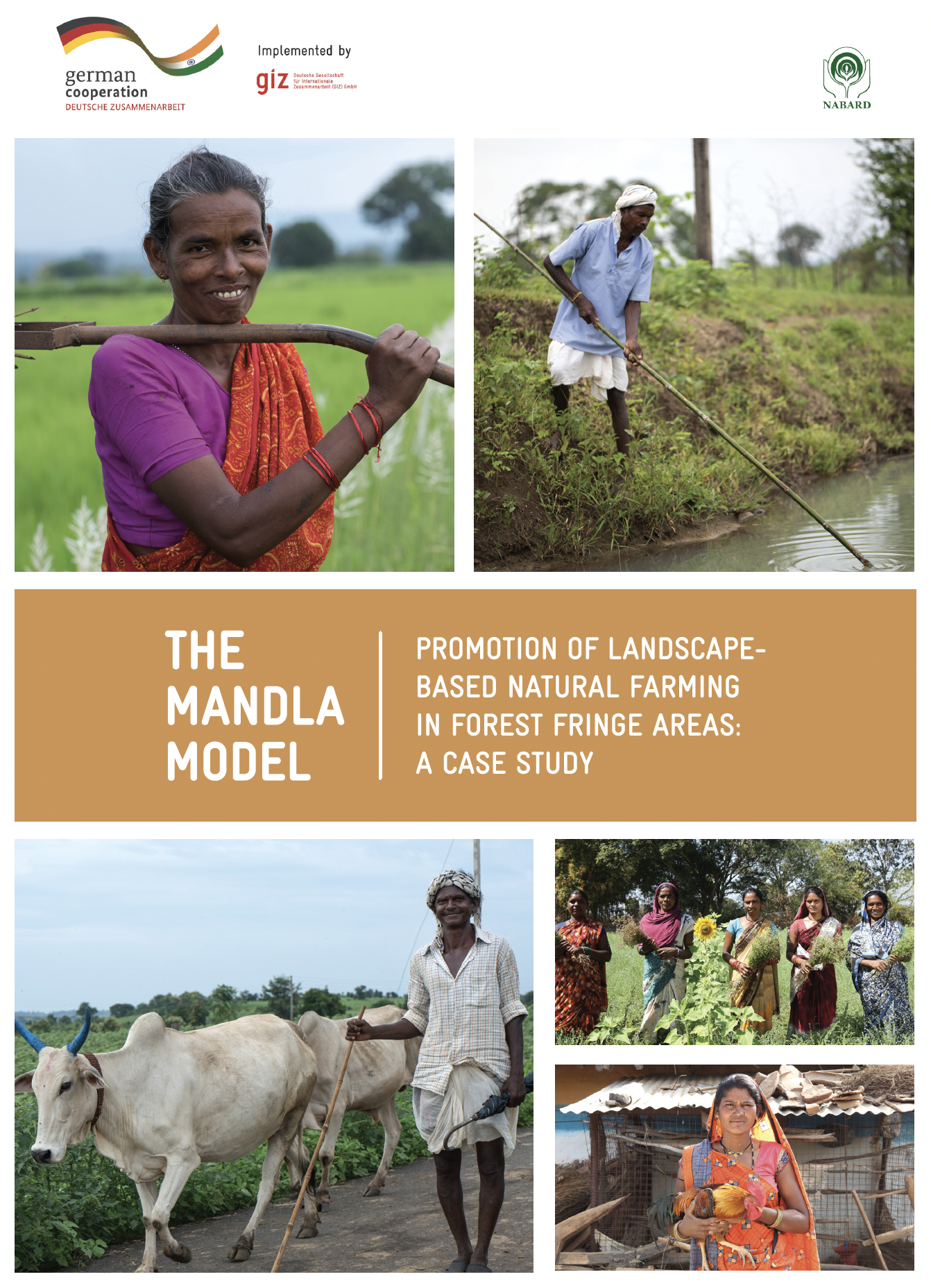
The Mandla Model | Promotion of landscape-based natural farming in forest fringe areas: A Case Study
Derived from decades of learnings from on-ground interventions in Madhya Pradesh, ProSoil project has created an integrated landscape approach called the ‘The Mandla Model’ to scale up Natural Farming. This document details the evolution of this approach and learnings that can be applicable in scaling up on Natural Farming practices in other locations within the country.
Composite Resource and Sustainable Soil Management (CRSSM) Plan
For Gram Panchayat - Jawla, Block - Jamkhed District - Ahmednagar, Maharashtra
Developed under the project Soil Protection and Rehabilitation for Food Security in India (ProSoil)
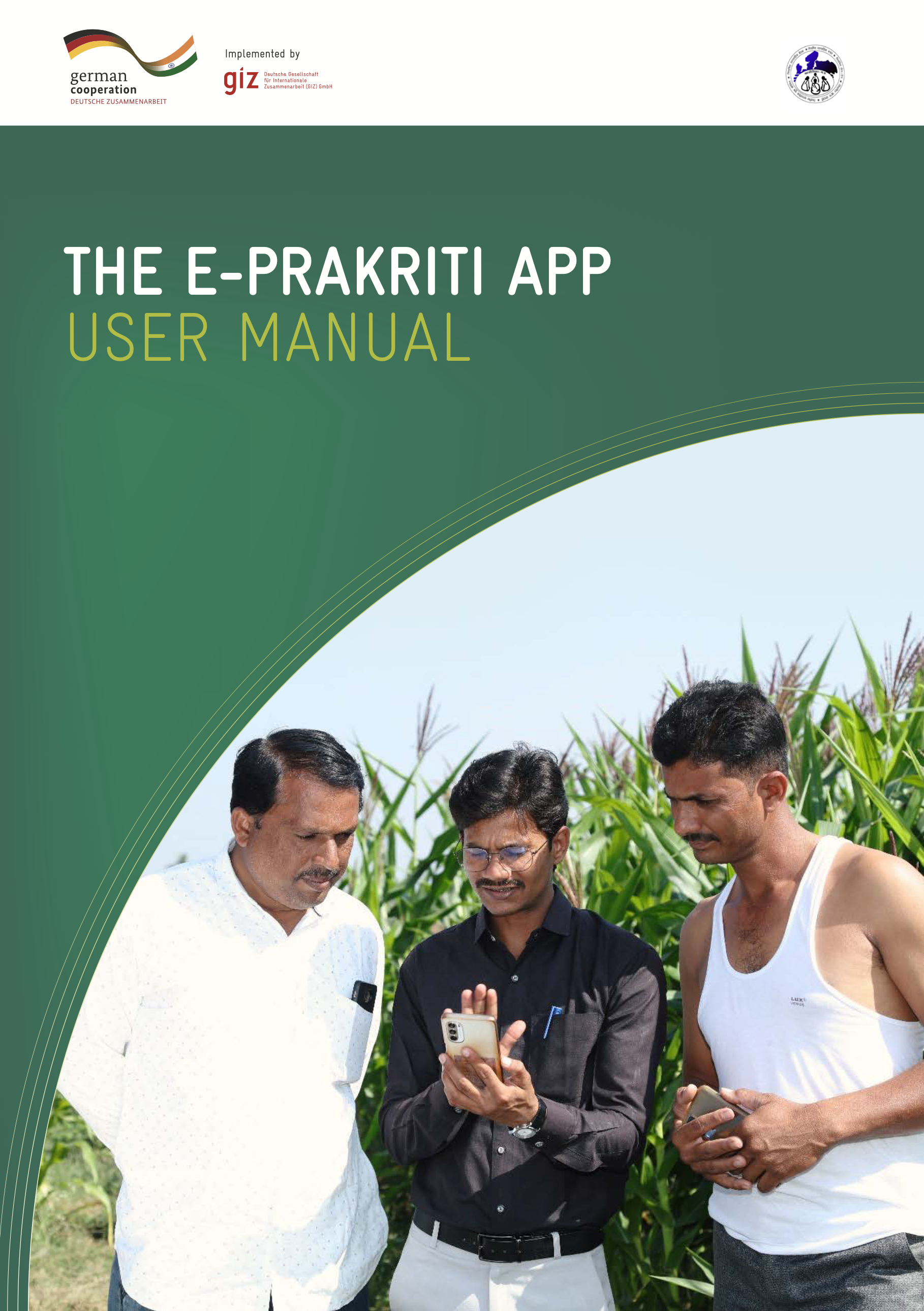
The e-Prakriti App use manual
The ProSoil project together with the Madhya Pradesh State Rural Livelihood Mission has developed e-Prakriti, a GIS-based planning tool to facilitate efficient and timely planning of scientific based-natural farming practices.
The e-Prakriti app is a planning, monitoring, evaluation, and learning application designed for seamless implementation of natural farming practices.
It aims to enhance the effectiveness of agricultural initiatives through advanced monitoring and learning mechanisms.
It is available as an easy-to-use mobile app for community resource persons (CRPs) in the field. It also features a comprehensive dashboard for managers and executives.

Governing soils sustainably in India: Establishing policies and implementing strategies through local governance
Years of chemical-intensive agricultural practices following the Green Revolution in the late 1960s have led to extensive soil degradation in India. This has implications for food security, farmers’ incomes, and the country's economy. However, domestic top-down policy mandates in recent times have favoured practices like natural farming with a view to slow down and eventually halt soil degradation. This is in line with the international Sustainable Development Goals (SDGs), one of which is focused on restoring degraded lands (SDG 15.3 aims to strive achieve land degradation neutrality). Taking cue from recent policy mandates on soil and land, this chapter posits the historical significance of the Panchayat — a village-level administrative institution in India — and argues for its involvement in policy implementation for soil rehabilitation at the village level, The article also makes a case for the introduction of an overarching National Soil Policy to encourage natural farming practices and biofertilizer use.

Mainstreaming circularity approaches for healthy soils in India: Learnings from piloting the Urban-Rural Nutrient & Carbon Cycle (URNCC) approach in Maharashtra
In India more than 54 million metric tons (MT) of municipal solid waste are generated every year of which 50% is organic. Without treatment, organic waste, containing valuable nutrients and carbon originating in agricultural fields, accumulates in urban environments. This loss of nutrients from rural agricultural landscapes contributes to its degradation. There is a potential to recycle urban organic waste into compost and other soil enhancing products to return nutrients and carbon back to the soils.

Sustainable Land Management (SLM): A compilation of SLM technologies and approaches in India
In India, ProSoil is implemented in the states of Maharashtra and Madhya Pradesh. The SLM practices from India in this compilation represent a broad spectrum of activities and interventions the project has undertaken since 2015. These practices are typified by local innovation and resource efficiency. They leverage local materials in a way that benefits soil health and is financially sustainable for farmers. Through its efforts, the project has helped rehabilitate 54,658 hectares of land in the implementation area. We have validated business models for products such as crop residue-based biochar and quality-tested urban organic waste-derived compost. This has cemented the financial viability of the project’s SLM practices, incentivising their self-sustaining proliferation.
While these interventions respond to specific challenges within each local context, there is also potential for applicability and scale in other regions. To explore and operationalise the practices, India and other ProSoil global programme partner countries have already been working consistently to deepen South-South SLM knowledge exchange.

URBAN-RURAL NUTRIENT& CARBON CYCLE (URNCC): Mainstreaming circularity approaches for sustainable urban development and healthy soils in Maharashtra
Almost 40% of India (147 million hectares) is affected by land degradation, and 3.7 million hectares suffer from depletion of soil organic matter and nutrients. The major drivers of land degradation are agricultural practices, improper irrigation, cultivation in vulnerable or low potential land, and overuse of agro-chemicals.
In India more than 54 million metric tons (MT) of municipal solid waste are generated every year of which 50% is organic. Without treatment, organic waste, containing valuable nutrients and carbon originating in agricultural fields, accumulates in urban environments. This loss of nutrients from rural agricultural landscapes contributes to its degradation. There is a potential to recycle urban organic waste into compost and other soil enhancing products to return nutrients and carbon back to the soils.

Urban Compost Business Model Case Example from Krushiyug Farmer Producer Company, Jalna, Maharashtra
The Indo-German development cooperation project ‘Soil Protection and Rehabilitation of degraded soil for food security in India (ProSoil)” is implemented by the Deutsche Gesellschaft für Internationale Zusammenarbeit (GIZ) GmbH on behalf of the German Federal Ministry for Economic Cooperation and Development (BMZ) in partnership with the National Bank for Agriculture and Rural Development (NABARD). The project is part of a larger global programme under BMZ’s Special Initiative “Transformation of Agricultural and Food Systems”. The project is implemented in the Indian states of Maharashtra and Madhya Pradesh, and works with local implementation and mainstreaming partners.
One of the initiatives under the project is establishing a business model for compost manufactured using organic waste matter from urban centres. This compost can then be employed for rural agricultural fields, thereby closing the urban-rural nutrient loop.
This detailed project report presents an urban compost business model from the district of Jalna in Maharashtra. Here, the project’s NGO partner Watershed Organisation Trust (WOTR) worked with the Krishiyug Farmer Producer Company (FPC) in establishing supply chains and sales of city compost.

Greenhouse gas emissions from Terra Preta substrates in India
For all investigated concepts, the production and application of the Terra Preta Substrate (TPS) lead to negative emission results under the selected assumptions, resulting from an assumed carbon sequestration that exceeds the greenhouse gas emissions from the production of the TPS. Whereby, the concepts with advanced pyrolysis technology are the most advantageous due to the reduced CH4 emissions from pyrolysis.
Emissions of methane and nitrous oxide from composting and pyrolysis process are by far the most significant emission sources in the overall result. The result shows a high influence of carbon sequestration in the overall balance. The carbon introduced and permanently sequestered, mainly via the biochar, leads to high CO2 credits.
TPS production, including pyrolysis and composting processes, and the application to agricultural soils interact with the environment and climate system in multiple complex ways, this results in many uncertainties.
In order to reduce these ranges in the future and to further increase the robustness of the accounting results, measurements of actual emission values or sequestered carbon should be taken regularly during the further implementation and operation of the investigated technologies in India.

Business Model for Bio-PROM: Case Example from Suvarnakranthi FPCL, Sindhudurg, Maharashtra
Indo-German development cooperation project ‘Soil Protection and Rehabilitation of Degraded Soil for Food Security in India (ProSoil) is implemented by Deutsche Gesellschaft für Internationale Zusammenarbeit (GIZ) GmbH on behalf of the German Federal Ministry for Economic Cooperation and Development (BMZ) in partnership with the National Bank for Agriculture and Rural Development (NABARD). The project is part of a larger global programme under BMZ’s Special Initiative “Transformation of Agricultural and Food Systems”. Under this project, GIZ India in collaboration with BAIF Development Research Foundation, is supporting an initiative in the Sindhudurg district of Maharashtra to prepare an organic manure called Bio-PROM using residue from biogas plants.
Bio-PROM can generally be produced using different sources like organic manure, plant-based biomass, de-oiled cakes, potassium hummate, to name a few.

BAIF Journal Special Issue: Water Stewardship Through Corporate Partnership
Read the latest edition of the BAIF Development Research Foundation's quarterly journal!