Resource Library
Any CA4SH partner can submit a resource to the Library, where we hope to increase visibility of diverse work related to improving soil health globally.
Please send a web link or a file to communications@coalitionforsoilhealth.org if you would like to submit a resource.
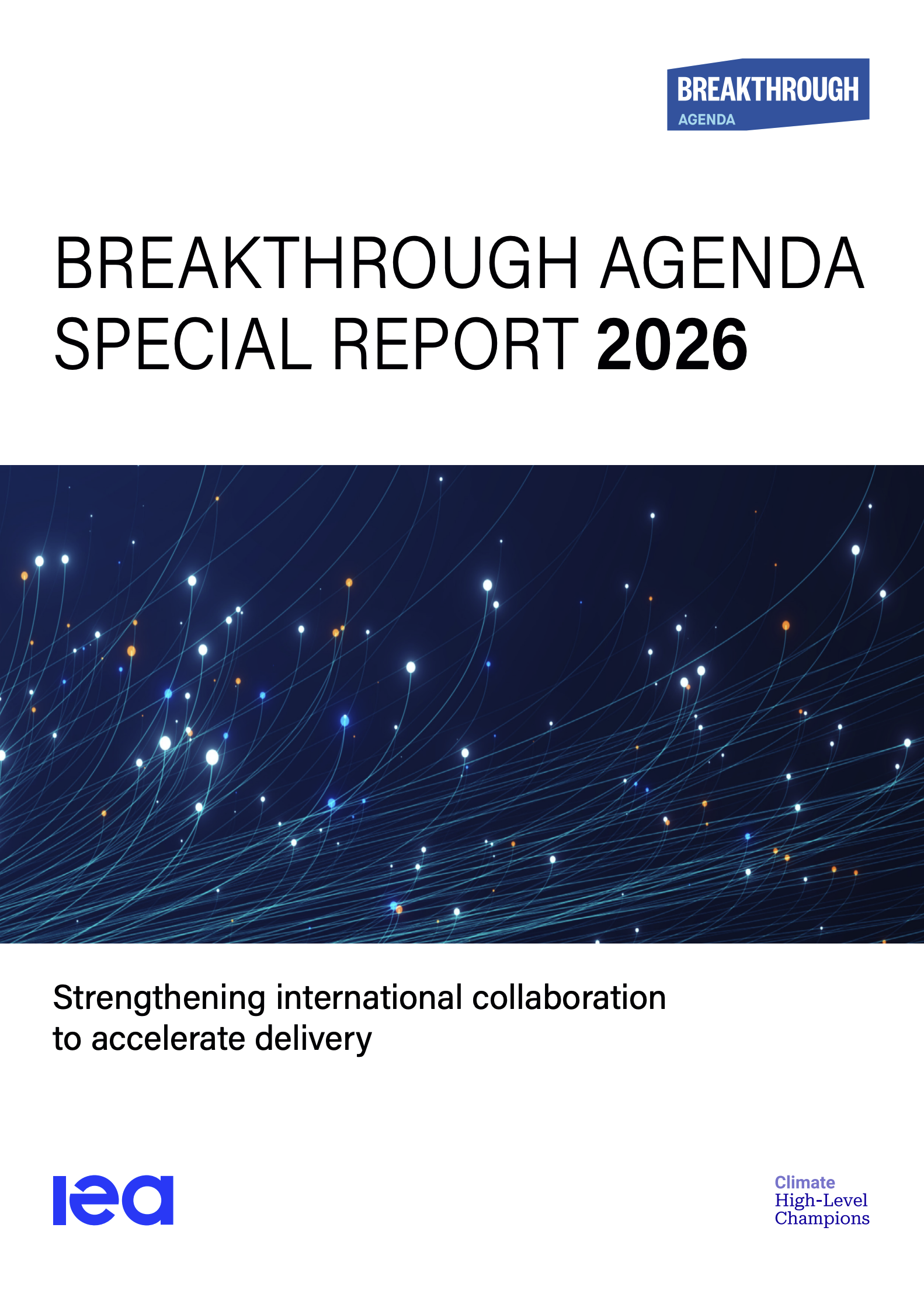
Breakthrough Agenda Special Report 2026
Building on previous editions in the Breakthrough Agenda series, this year’s report identifies a set of near-term priorities aimed at improving conditions for investment, deployment and market development ahead of the next Global Stocktake in 2028.
Launched at COP26 in 2021, the Breakthrough Agenda provides a framework for strengthening international collaboration across major emitting sectors, with the aim of making clean technologies and sustainable solutions the most affordable, accessible and attractive option by 2030.

Breakthrough Agenda Report 2025: Accelerating sector transitions through stronger International collaboration
Since its launch at COP 26, the Breakthrough Agenda has become established as an annual collaborative process centred around the Conference of the Parties (COP) meetings of the United Nations Framework Convention on Climate Change (UNFCCC). It is currently supported by over 60 countries representing over 80% of global GDP, and by over 150 initiatives working to enhance collaboration within major emitting sectors. Countries can endorse Breakthrough goals to make clean technologies and sustainable practices more affordable, accessible and attractive than their alternatives by 2030 in the power, road transport, hydrogen, steel, cement and buildings sectors.
The Breakthrough Agenda establishes an annual cycle to track developments towards these goals, identify where further co-ordinated international action is urgently needed to accelerate progress and then galvanise public and private international action behind these specific priorities in order to make these transitions quicker, cheaper, and easier for all.
To initiate this cycle, world leaders tasked the IEA and the Climate High-Level Champions to develop an annual Breakthrough Agenda report to provide an independent evidence base and expert recommendations for where stronger international collaboration is needed. From 2022-2024, the reports contained a detailed assessment on the state of international collaboration across these sectors in areas such as definitions, standards and certification, demand creation and management, research and innovation, finance and investment, infrastructure, and trade conditions, among others.
The Breakthrough Agenda Report 2025 – the fourth in the annual series – takes a different approach to previous reports, in that it does not contain the same detailed sector-by-sector assessment. Instead, this year’s report focuses on enhancing the methodology behind the detailed progress assessments, provides practical examples of collaboration through deep dives, and introduces a new focus chapter on fertilisers.

Food Systems Call to Action: A shared vision for transformation and urgent action
At COP 28, a diverse and powerful group of nonState actors6 came together to launch the Food Systems Call to Action for Transforming Food Systems for People, Nature and Climate (Food Systems CtA). Representing farmers and frontline communities, businesses, philanthropies, cities, consumers and many others, this broad coalition delivered a strong message to assembled world leaders and the global community gathered for the 28th Conference of Parties (COP 28) to the United Nations Framework Convention on Climate Change (UNFCCC) that all actors must take urgent action to transform food systems to deliver positive outcomes for people, nature and climate.
Developed through a consultative process in 2023, the Food Systems CtA is a 2-page text, available in 7 languages, that highlights 10 priority actions and 4 principles intended to unlock the transformative potential of food systems. It centres on the need to support farmers and other frontline food systems actors, with a particular focus on women and youth, as well as vulnerable communities. Incorporating feedback from hundreds of individuals and entities, the final text was published on the High-Level Champions website along with an endorsement process. This process includes the submission of a Statement of Action for endorsers to emphasise additional priority points and detail the actions they are taking that align with the CtA, promoting transparency and accountability. The full list of current endorsers is available on the High-Level Champions website. The Food Systems CtA will remain open for endorsement by non-State actors until COP 30 in Belem.