
Resource Library
Any CA4SH partner can submit a resource to the Library, where we hope to increase visibility of diverse work related to improving soil health globally.
Please send a web link or a file to communications@coalitionforsoilhealth.org if you would like to submit a resource.

AgroSense: An Integrated Deep Learning System for Crop Recommendation via Soil Image Analysis and Nutrient Profiling
This B.Tech Agricultural Engineering project is based on the recent AI/ML research direction 'AgroSense: An Integrated Deep Learning System for Crop Recommendation via Soil Image Analysis and Nutrient Profiling'. The project connects agricultural engineering with artificial intelligence, machine learning, deep learning, IoT, computer vision, drone analytics, or RAG-style decision support. Students can use the linked 2023-onward paper/source as the academic base and convert it into an implementation-focused final-year project with sensors, datasets, dashboards, mobile/web interfaces, prediction models, or prototype automation.
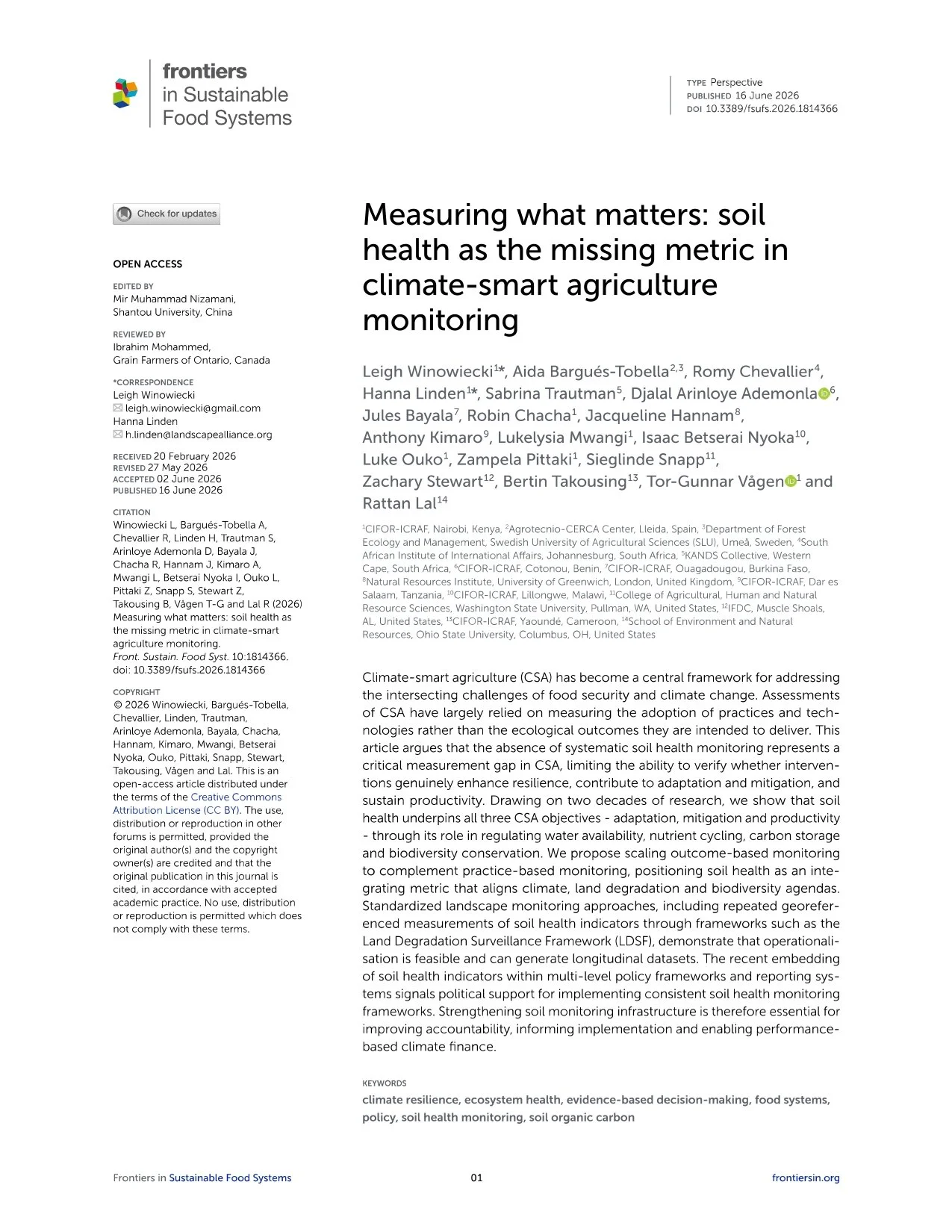
Measuring what matters: soil health as the missing metric in climate-smart agriculture monitoring
Frontiers in Sustainable Food Systems Special Feature on Climate-Smart Food Systems
Abstract
Climate-smart agriculture (CSA) has become a central framework for addressing the intersecting challenges of food security and climate change. Assessments of CSA have largely relied on measuring the adoption of practices and technologies rather than the ecological outcomes they are intended to deliver. This article argues that the absence of systematic soil health monitoring represents a critical measurement gap in CSA, limiting the ability to verify whether interventions genuinely enhance resilience, contribute to adaptation and mitigation, and sustain productivity. Drawing on two decades of research, we show that soil health underpins all three CSA objectives - adaptation, mitigation and productivity - through its role in regulating water availability, nutrient cycling, carbon storage and biodiversity conservation. We propose scaling outcome-based monitoring to complement practice-based monitoring, positioning soil health as an integrating metric that aligns climate, land degradation and biodiversity agendas. Standardized landscape monitoring approaches, including repeated georeferenced measurements of soil health indicators through frameworks such as the Land Degradation Surveillance Framework (LDSF), demonstrate that operationalisation is feasible and can generate longitudinal datasets. The recent embedding of soil health indicators within multi-level policy frameworks and reporting systems signals political support for implementing consistent soil health monitoring frameworks. Strengthening soil monitoring infrastructure is therefore essential for improving accountability, informing implementation and enabling performance-based climate finance.