Resource Library
Any CA4SH partner can submit a resource to the Library, where we hope to increase visibility of diverse work related to improving soil health globally.
Please send a web link or a file to communications@coalitionforsoilhealth.org if you would like to submit a resource.
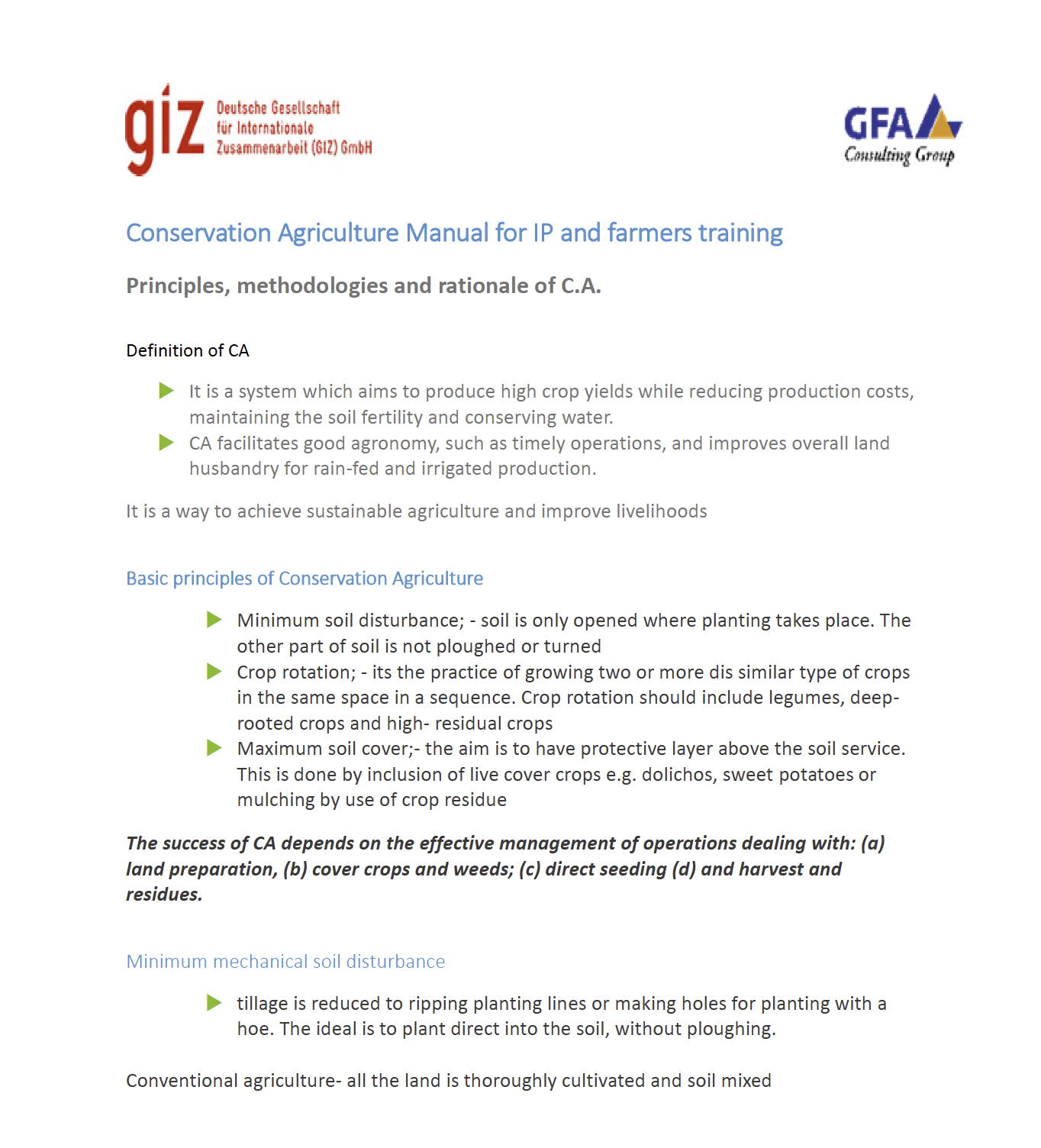
Conservation Agriculture Manual for IP and farmers training - Kenya
Conservation Agriculture is a system which aims to produce high crop yields while reducing production costs, maintaining the soil fertility and conserving water. CA facilitates good agronomy, such as timely operations, and improves overall land husbandry for rain-fed and irrigated production. It is a way to achieve sustainable agriculture and improve livelihoods.
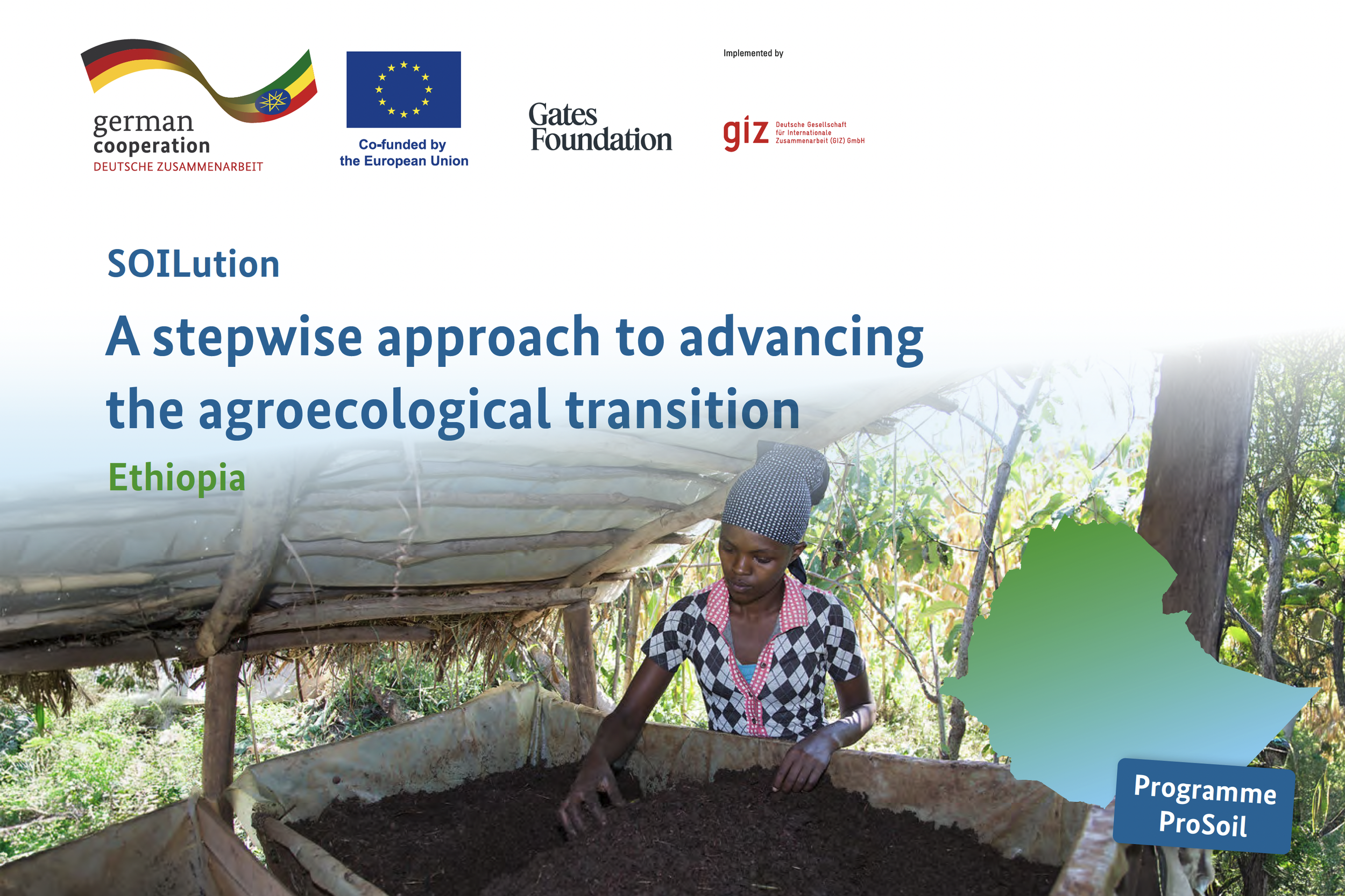
SOILution: A stepwise approach to advancing the agroecological transition - Ethiopia
The approach to the agroecological transition offers a practical and scalable pathway to transform farming systems into resilient, integrated production landscapes. Originally presented in a CIAT publication
(Sanginga and Woolmer, 2019), the approach was adapted to and tested in Ethiopia’s Highlands by the ProSoil programme, responding to severe soil degradation that undermines food security and rural livelihoods.
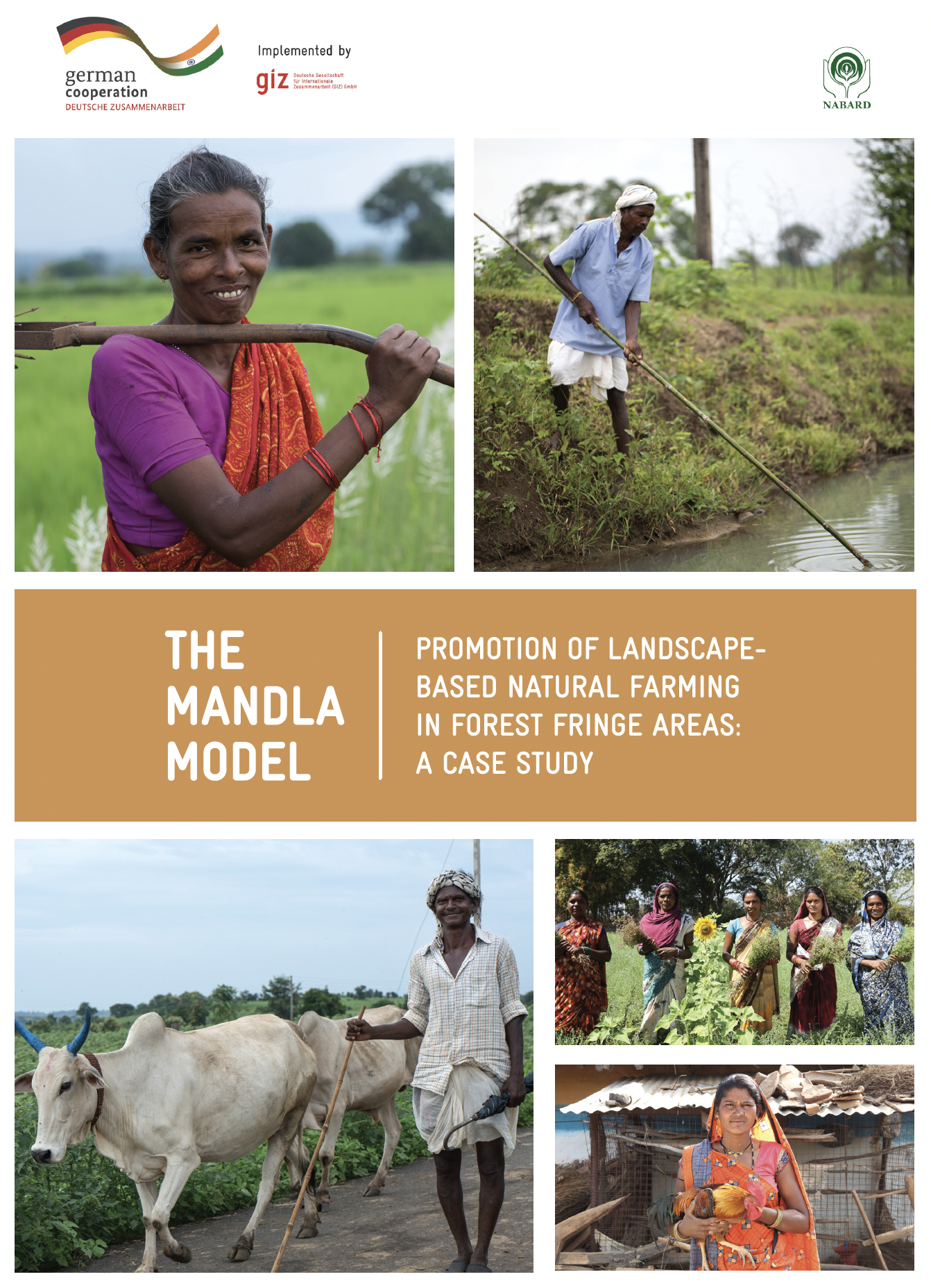
The Mandla Model | Promotion of landscape-based natural farming in forest fringe areas: A Case Study
Derived from decades of learnings from on-ground interventions in Madhya Pradesh, ProSoil project has created an integrated landscape approach called the ‘The Mandla Model’ to scale up Natural Farming. This document details the evolution of this approach and learnings that can be applicable in scaling up on Natural Farming practices in other locations within the country.
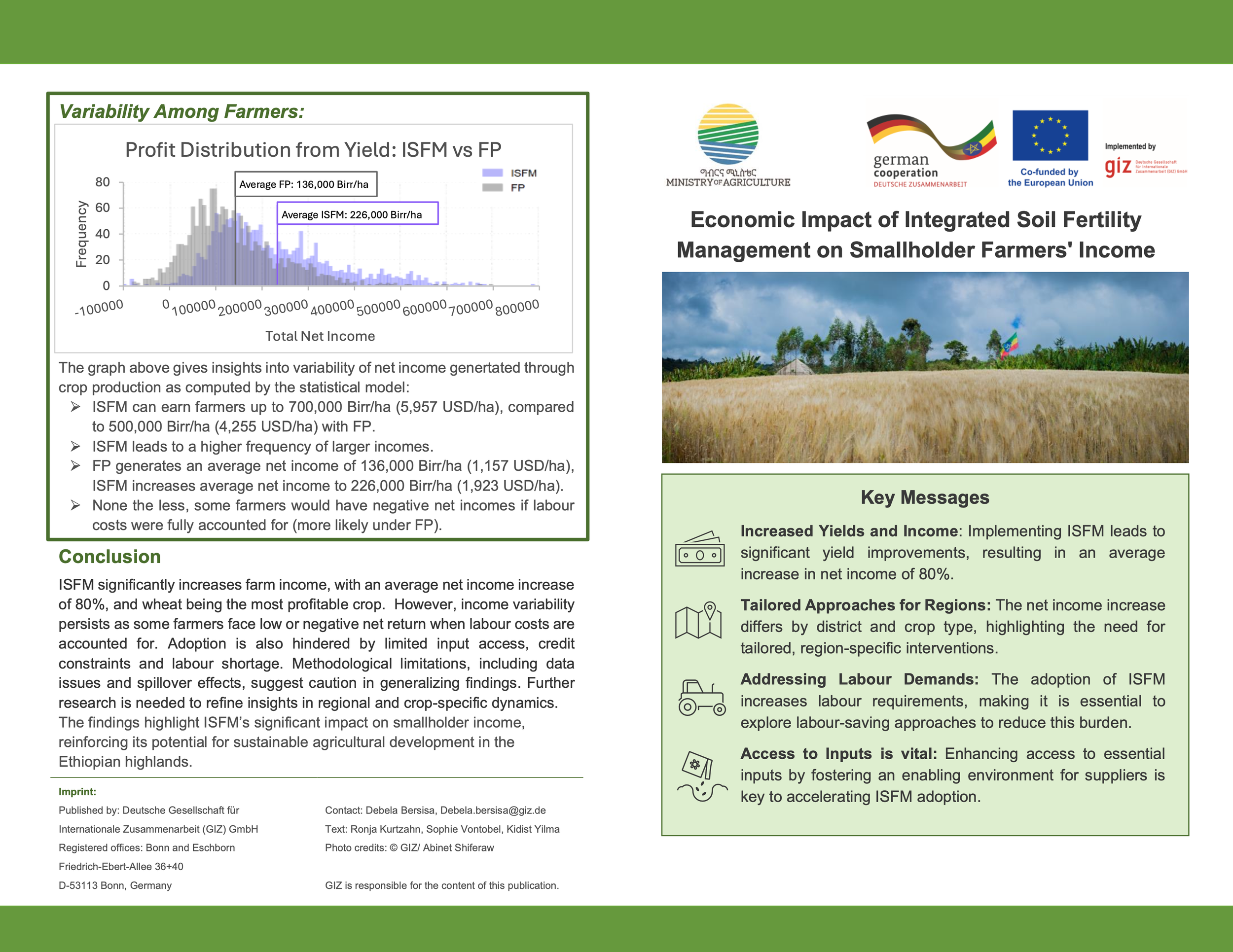
Economic Impact of Integrated Soil FertilityManagement on Smallholder Farmers' Income
Soil health is essential for agricultural productivity, yet over 50% of Ethiopia’s highland farmland is degraded due to erosion, low organic matter, and acidification, threatening food security and farmers’ livelihoods.
To address this challenge, the Integrated Soil Fertility Management Project (ISFM+), implemented by GIZ Ethiopia, promotes Integrated Soil Fertility Management (ISFM) to improve soil health and crop yields.

Cross-Country Analysis on Integrating Farmers’ Knowledge into Extension Approaches for Accelerated Agroecological Transition
This report examines agricultural extension approaches that integrate farmers' knowledge to accelerate agroecological transitions in Benin, Ethiopia, Kenya, and Madagascar. It assesses how advisory services support sustainable farming, foster knowledge-sharing, and ensure long-term farmer engagement.

Mainstreaming circularity approaches for healthy soils in India: Learnings from piloting the Urban-Rural Nutrient & Carbon Cycle (URNCC) approach in Maharashtra
In India more than 54 million metric tons (MT) of municipal solid waste are generated every year of which 50% is organic. Without treatment, organic waste, containing valuable nutrients and carbon originating in agricultural fields, accumulates in urban environments. This loss of nutrients from rural agricultural landscapes contributes to its degradation. There is a potential to recycle urban organic waste into compost and other soil enhancing products to return nutrients and carbon back to the soils.

URBAN-RURAL NUTRIENT& CARBON CYCLE (URNCC): Mainstreaming circularity approaches for sustainable urban development and healthy soils in Maharashtra
Almost 40% of India (147 million hectares) is affected by land degradation, and 3.7 million hectares suffer from depletion of soil organic matter and nutrients. The major drivers of land degradation are agricultural practices, improper irrigation, cultivation in vulnerable or low potential land, and overuse of agro-chemicals.
In India more than 54 million metric tons (MT) of municipal solid waste are generated every year of which 50% is organic. Without treatment, organic waste, containing valuable nutrients and carbon originating in agricultural fields, accumulates in urban environments. This loss of nutrients from rural agricultural landscapes contributes to its degradation. There is a potential to recycle urban organic waste into compost and other soil enhancing products to return nutrients and carbon back to the soils.

Urban Compost Business Model Case Example from Krushiyug Farmer Producer Company, Jalna, Maharashtra
The Indo-German development cooperation project ‘Soil Protection and Rehabilitation of degraded soil for food security in India (ProSoil)” is implemented by the Deutsche Gesellschaft für Internationale Zusammenarbeit (GIZ) GmbH on behalf of the German Federal Ministry for Economic Cooperation and Development (BMZ) in partnership with the National Bank for Agriculture and Rural Development (NABARD). The project is part of a larger global programme under BMZ’s Special Initiative “Transformation of Agricultural and Food Systems”. The project is implemented in the Indian states of Maharashtra and Madhya Pradesh, and works with local implementation and mainstreaming partners.
One of the initiatives under the project is establishing a business model for compost manufactured using organic waste matter from urban centres. This compost can then be employed for rural agricultural fields, thereby closing the urban-rural nutrient loop.
This detailed project report presents an urban compost business model from the district of Jalna in Maharashtra. Here, the project’s NGO partner Watershed Organisation Trust (WOTR) worked with the Krishiyug Farmer Producer Company (FPC) in establishing supply chains and sales of city compost.

STORIES OF IMPАСТ MAGAZINE | The Power of the People: Driving Africa's Food Agenda
This document, encompassing various success stories and strategic insights, highlights the diverse contributions of Non-State Actors in advancing agricultural development. It features case studies such as Pambana Enterprise in Zambia, which exemplifies youth-led initiatives in reducing post-harvest losses and promoting food security and climate resilience. The role of media, as demonstrated by Sydney Katunga Phiri, is underscored as crucial for translating complex agricultural policies, fostering public accountability, and building a continental narrative around key themes like youth agripreneurship, gender inclusion, and climate-smart agriculture.

2024 Annual Report | Center for Rural Empowerment and Agricultural Transformation for Sustainability (Creats International)
Presenting the 2024 Annual Report of the Center for Rural Empowerment and Agricultural Transformation for Sustainability (Creats International). Through your generous donations, strong partnerships, and unwavering support, we achieved remarkable milestones captured in this report.
As we celebrate ten years since our founding, we extend our heartfelt gratitude for walking with us on this transformative journey. Together, we look forward to deepening our impact and continuing to empower communities to move from merely surviving to truly thriving.
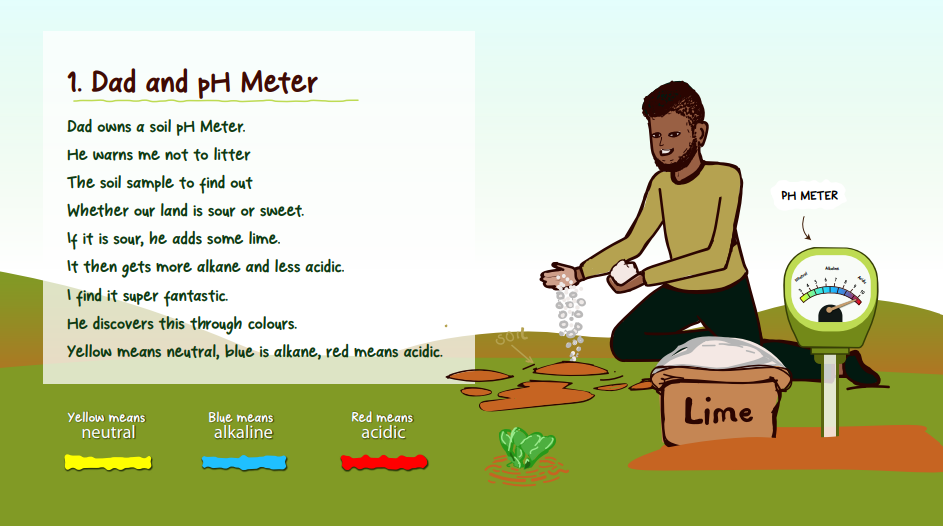
My Family Cares for Soil
My Family Cares for Soil is an educational children's booklet by Eliseus Bamporineza, a Soil Health Advocate and Youth4Soil member of the Coalition of Action for Soil Health (CA4SH).
It is an engaging and educational booklet that follows a young girl’s journey as she explores soil health monitoring alongside family members. Each family member uses specific tools, like pH meters, moisture meters, and drones, to gather and analyze data on soil quality, helping the child understand the importance of caring for soil to improve farming outcomes. This story introduces children to scientific tools in a relatable way, showing how testing soil’s pH, moisture, temperature, and nutrient levels can lead to healthier crops and more sustainable farming. Through vibrant illustrations and simple explanations, the booklet covers essential soil care practices like moisture checking, nutrient testing, and mapping soil types. Designed as a learning resource each family member in the book showcases a specific tool used to monitor and enhance soil health, making the content accessible and relatable for children in their quest to know about soil and the importance of gathering information about it.

Production, Regeneration and Networking Innovation in Argentina: GoodPractices and Lessons Learned from Farmers in Argentina
The Carbon Gap Network or Red de Brechas de Carbono (RBC) project from the Argentine No-Till Farmers Association (Aapresid) takes localized information on climate and the environment and translates it into actionable recommendations for farmers on the ground to maximize their soil’s organic carbon, and foster overall healthier soils.

The Road Ahead for Soil Health Action: A Call to Action from the 2024 CA4SH Webinar Series
The Coalition of Action 4 Soil Health (CA4SH) is a multi stakeholder partnership committed to scaling soil health, globally. CA4SH ’s membership base comprises stakeholders from member states, the private sector, research institutions, civil society, farmer organisations, multilateral organisations, and NGOs.
To leverage the wealth of knowledge and experiences from across our partners in addressing key challenges currently constraining farmers to implement healthy soil practices, CA4SH held a three-part virtual Webinar Series in early 2024. The 2024 Webinar Series was held over three sessions under the topics of bringing soil health into policy, science & knowledge for improving and monitoring soil health, and financing healthy soil practices. The objectives were to explore soil-related themes and share experiences with a focus on tailoring and scaling successful methodologies.
This brief summarizes the sessions, and coallates lessons learned, calls to action, and opportunities for scaling these approaches to align action on soil ahead of the 2024 Rio Conventions.

Payments for Ecosystems Services to Support Transitions to Sustainable Agriculture and Land Use
This brief focuses on Payments for Ecosystems or Environmental Services (PES) as a mechanism for providing incentives to land users to transition to more sustainable land management.
Agriculture and food systems are both drivers and victims of escalating climate and nature crises, in turn increasing the risks to healthy diets, livelihoods and economies. Public policies can set incentives for farming and market practices that further exacerbate these trends, but they can also play a role in reversing them. The global Agriculture Policy Dialogue on Transition to Sustainable Agriculture is a peer-to-peer platform to share experience, facilitate partnerships and catalyse policy leadership to accelerate the transition to sustainable agriculture and food systems that benefit people, prosperity and the planet.
Policy Pathway Briefs provide an overview of emerging experiences and lessons on policy approaches that contribute to this transition, covering a series of topics requested by Policy Dialogue members, to support peer leaning and knowledge exchange. The briefing notes are in no way exhaustive. The options facing governments will be context specific and look different across and within countries. The notes aim to act as a discussion starter and to facilitate exchanges between countries engaged in the Agriculture Policy Dialogue and with other global initiatives, drawing on the experiences presented by members and examples identified through further research.

Promoting Healthy Soils and Land
This brief focuses on soil health, identifying policy instruments and actions for governments to provide incentives and support to farmers to protect and restore agricultural soils.
Agriculture and food systems are both drivers and victims of escalating climate and nature crises, in turn increasing the risks to healthy diets, livelihoods and economies. Public policies can set incentives for farming and market practices that further exacerbate these trends, but they can also play a role in reversing them. The global Agriculture Policy Dialogue on Transition to Sustainable Agriculture is a peer-to-peer platform to share experience, facilitate partnerships and catalyse policy leadership to accelerate the transition to sustainable agriculture and food systems that benefit people, prosperity and the planet.
Policy Pathway Briefs provide an overview of emerging experiences and lessons on policy approaches that contribute to this transition, covering a series of topics requested by Policy Dialogue members, to support peer leaning and knowledge exchange. The briefing notes are in no way exhaustive. The options facing governments will be context specific and look different across and within countries. The notes aim to act as a discussion starter and to facilitate exchanges between countries engaged in the Agriculture Policy Dialogue and with other global initiatives, drawing on the experiences presented by members and examples identified through further research.